


‘World records are made to be broken’. That’s how the saying goes, right? This January Kenenisa Bekele, the distance running legend, lost the last of his 5 world records in the indoor 2000m to Hobbs Kessler of the USA, and that was the headlining phrase used to quell any doubts about the strength of his legacy. So how come when we saw all those road running records start to crumble after 2019, all of a sudden we were cursing carbon shoe technology and calling for asterisks by their side? And yet when it comes to some of the longest standing world records like Jarmila Kratochvilova’s 1:53.28 800m, we point fingers, cry doping, and consider them unofficially broken anyway. It begs the question: are we being too precious about our world records? And does it really matter how, or if, they’re broken.


Josh Hoey’s indoor 800m world record
The New Balance Indoor Grand Prix was the catalyst for this whole discussion. That night we saw two world records fall at the hands of a 2026 season opener. It was as if all it took were one good winter training block, and bang, you’re there. It was Josh Hoey’s race in particular though, that caught people’s attention. The 800m world indoor record he broke was 29 years old, set by Wilson Kipketer in 1997. This performance was of course closely followed by the usual fanfare, because for a time to remain unbeaten for almost 3 decades must mean there’s some level of near impossibility in there. But it’s never long before the existential questioning begins. Is Josh Hoey now the best to ever do it? Was his record breaking run more impressive than the one that came before it?
How does Josh Hoey’s run compare to Wilson Kipketer’s?
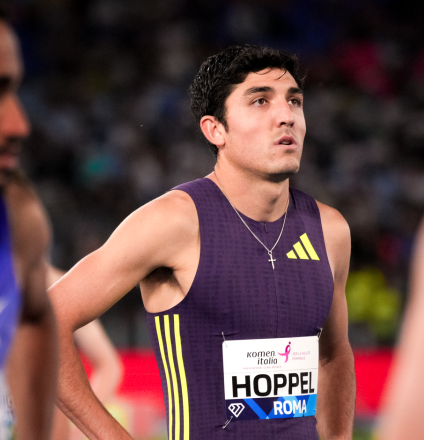
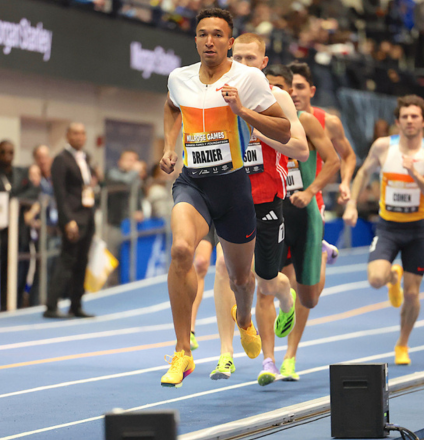
The questions are the same every time. Except unfortunately for Josh Hoey, there is one key difference between his race and the one that came 28 years before. Wilson Kipketer ran his 1:42.67 at the World Indoor Championships. A race with stiff competition, no pacemaking, and in which the main goal was positioning, not time. Hoey on the other hand had the perfect set up. To start with his main rivals Donavan Brazier and Bryce Hoppel just so happened to be running in a 600m race earlier on in the programme, leaving the 800m race, rather conveniently, free of any real competition.
Then we have the run itself, which from the very beginning was broadcast as a world record attempt, with Josh Hoey enlisting the help of his brother Jaxson, alongside wavelight technology, to pace him straight into the history books. To put it plainly, the circumstances couldn’t have been more different. One was an all-out fight to the finish, and the other was a one-man fight to keep up with some green flashing lights. Two different methods, but still just one result: world record.


Can fast times and competitive racing coexist?
And yet for many it isn’t: the method isn’t a means to an end, it’s a means that affects the end. Josh Hoey did what no other man could but he did it wrong. Wilson Kipketer’s record is better, more impressive, because, get this: it just happened. In that case though, do we even want world records to be broken at all? If you think about the 800m there’s no denying that what Kipketer did is incredibly impressive. In such a technical event you have to be strategic, and that can come at the cost of fast times, with races often lying at one extreme: a flat out effort, or a slower, more competitive race.
How likely is it that Josh Hoey would have broken that world record in any other race? If Donovan Brazier and Bryce Hoppel had been involved, would he still have done it? Suddenly the answer doesn’t seem so clear. That’s the problem with the 800m; if we want records, it’s most likely that what we’ll have to settle for is a showcase, not a race. The only actual criteria for a world record is to run faster, and that’s exactly what Josh Hoey did.

How does this apply to sprint world records?
This point is interesting when it comes to sprint world records; to run faster is not only what you have to do, it’s the only thing you can do. No wavelights, no pacers, just you and your best effort. Except sometimes what we hate isn’t the method, it’s the player. Take Flo Jo for example, world record holder in the 100m and 200m. Or Marita Koch, 400m world record holder. Two of the longest-standing world records in athletics, and also two of the most controversial. Now I’m not here to discuss whether they were or weren’t in fact doping, because that answer isn’t and will never be known to anyone.
My point is does it even need to be? Elaine Thompson-Herah in 2021, came within 0.05 seconds of the 100m world record with 10.54. Shericka Jackson was 0.07 off the 200m mark in 2023 with 21.41, and most recently Sydney Mclaughlin-Levrone in the 400m, 0.18 away with last year’s 47.78. Each of these three not only came within touching distance of the world record, but just as equally distinguished themselves from the rest of their field. What they did was prove that what may have been achieved by doping, can in fact be achieved without. World records at their heart are fallible, and these three are no different.
Is shoe technology changing how we perceive world records?
It all comes down to one thing: progression. People are advancing, technology is advancing, and with that will come new records. They may arrive sooner in some events than others but that doesn’t make it any less of a fact. It’s not lost on me the irony that 5 years on from the outcry of ‘technological doping’, which saw 6 of the top 10 men’s marathon times outrun by carbon-plated shoes, a world record-breaking attempt that revolved around the use of that exact same technology was being held and widely celebrated. Faith Kipyegon wanted to prove that anything is possible, and making the most of the latest advancements is exactly how you do so. Do you think Wilson Kipketer would have said no to wavelights, to super shoes, if it meant he could run even faster? Should he?


The sub-2 hour marathon debate
That question is particularly poignant when we think about the changes that have been taking place in marathon running. For the most part, the debate over carbon-plated shoes has come to a close. They’re no longer seen as an unfair advantage, but as a natural enhancement almost all athletes can benefit from. It’s the other factors, the wavelights and the pacemakers, that have taken centre stage instead. All thanks to Sabastian Sawe and Yomif Kejelcha breaking the 2 hour barrier at the 2026 London Marathon. Eliud Kipchoge broke that same barrier in 2019 in manufactured conditions. Sabastian Sawe and Yomif Kejelcha broke it in nothing but pure race conditions.
So what now? Are we less impressed with Eliud Kipchoge’s performance as a result? All these showcase world record attempts, are they nothing but an excuse to market technology when the focus should be on the actual athletes themselves? We thought they needed the speedsuit, the wind-blocking pacemakers, the wavelights, but no. Swap all those three for tough competition, and they can do it without. And what’s more, they can surprise us in the process.


Does how world records are broken matter to you?
I took those exact questions to the public, and this is what came out. Out of 154 voters, 77% said they would rather see world records broken in a race setting, and only 5%, 8 people, voted for showcase attempts. Which is ironic, because the latter is what we see most of nowadays, and yet at this year’s Paris Diamond League when Audrey Werro attempted to break the 800m world record running solo with only wavelights to follow, she couldn’t. Why? Because like she said herself, nothing propels you forward quite like competition. I started this article talking about Josh Hoey’s indoor 800m world record, and while the distance is the same, the circumstances here are the stark opposite. A stacked field might be just what’s needed to take this women’s outdoor record down. Like so many other things, world records don’t fit into the one-size-fits-all category.
When it comes to Eliud Kipchoge’s sub-2 hour effort, opinion was more divided. Some said Sabastian Sawe’s result changed their perspective on the INEOS 1:59 challenge, made it seem less ground-breaking and more rule-breaking, and others said it made no difference at all. Maybe because apart from the numbers 1:59, the two races have almost nothing in common.


Times change, literally. World records have to be taken as they come, but it’s up to you to reserve judgement on the how. Either way, they still represent one thing: the fastest time ever known to man.
Written by- Rosana Ercilla

