




Today’s performances at the London Marathon are worthy of so many words and yet here we are left speechless. What we once thought was impossible is now very much possible. So much so that it skipped the in-between stage and went straight to reality. Or maybe it was always possible? Maybe, just maybe, it takes two, to break two.
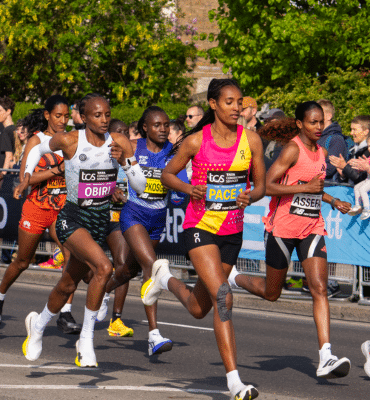
London Marathon Elite Women’s Race
The fact that I couldn’t start writing even a word of this article until the very last second says a lot. The elite women’s London Marathon may have started off as a chase for times, but in the end it was the racing that prevailed. Although thankfully, not totally at the cost of fast times.
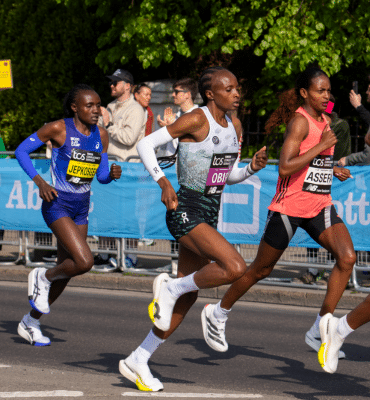
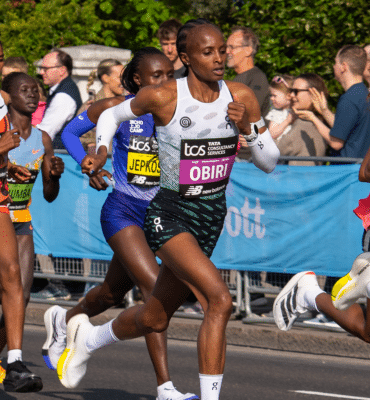
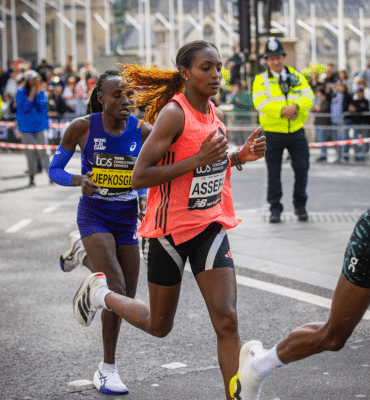
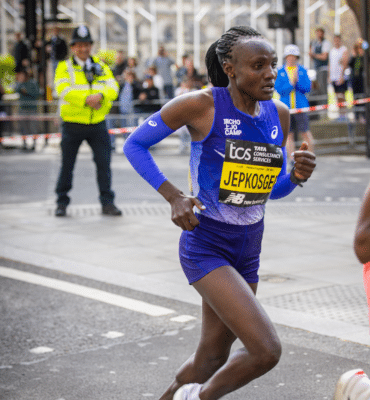
From the very start until the very end, the race was made up of three women. Reigning champion Tigist Assefa. 2025 New York City Marathon winner Hellen Obiri. And 2025 London Marathon second place finisher Joyciline Jepkosgei. What was initially the lead pack, became the podium. Although the race itself wasn’t quite that simple.
Tigist Assefa was the one who set the initial tone. A tone which would have meant a new London Marathon course record as well as a women’s-only world record, with a halfway split of 66:12 putting them on track for a 2:12 finish. But these women were so evenly matched that when the pacemakers dropped out and the pace slowed, not even Tigist Assefa was willing to pick it back up and risk the win as a result. Each of the three were tracking the other’s every move. While we, the public, desperately tried to figure out who it was that looked the strongest. Which was no easy task, given that Tigist Assefa and Hellen Obiri have complete opposite running styles. Where Assefa is calm, Obiri is ragged, and neither one paints an accurate picture of what is actually going on.
A tight race to the finish
By 30km, Tigist Assefa was starting to surge slightly but still looked reluctant to take the lead, encouraging Hellen Obiri to come forward instead. Which, despite her tendency for a strong sprint finish, she surprisingly did. That was how it remained right up until the last kilometre, where the top three evened out once again just in time to let the real race begin. This stage couldn’t be more difficult for the athletes yet more exciting for the public at the same time. Move too early and your body will shut down right when you need it most. But wait too long, and the win will slip straight through your fingers.
With 600m to go Tigist Assefa made her charge for the finish, pumping hard and hard enough that neither Hellen Obiri nor Joyciline Jepkosgei had the strength to respond. By this point any chance at a course record was gone. But if Tigist Assefa was going to win her second consecutive London Marathon title, she didn’t just want it to be a repeat of last year. She had to outdo herself. With that came a new women’s-only world record of 2:15:41, 9 seconds faster than her winning time from 2025.
Paula Radcliffe’s London Marathon time of 2:15:25 is now 23 years old. The longstanding course record of any marathon major, men or women, and the only to be held by a home athlete. Maybe that’s where its super-strength comes from.
London Marathon Women’s Podium:
- Tigist ASSEFA (ETH) 2:15.41
- Hellen OBIRI (KEN) 2:15:53
- Joyciline JEPKOSGEI (KEN) 2:15:55
London Marathon Elite Men’s Race
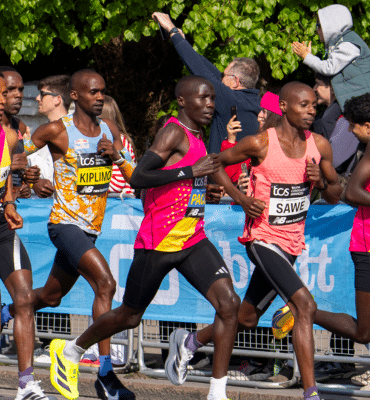
Where to even begin? Maybe 2017, when Eliud Kipchoge made the first real attempt at breaking 2 hours in the marathon? Because fast forward nearly 9 years later, to a race with no interchangeable pacemakers, no manufactured conditions, and we’ve finally seen success. Twice. It’s about more than just the breaking of a time barrier. It’s about the fact that 2 men did it at the same time, in the same race, and what a race it was.
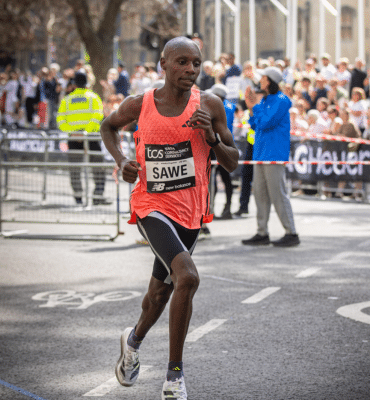
For Sabastian Sawe, the reigning London Marathon champion from 2025, his confidence was palpable from the start. Having run sub-2:03 marathons in each of his last 3 races Kelvin Kiptum’s London course record of 2:01:25 seemed certain to go. We just didn’t necessarily expect his world record to be sent down crashing with it. And definitely not in the way it did. When an athlete says they’re feeling confident, take them at their word, and double your expectations.
Yomif Kejelcha defies all expectations
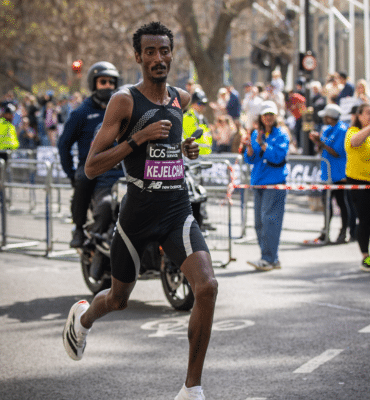
Speaking of underestimating achievements, Yomif Kejelcha’s London Marathon race was a prime example. He may be the second fastest man of all time over 5km, 10km and the half marathon but this was still his debut, so his choice to stick with the lead pack from the very get-go was a bold one, and an unexpected one at that. It was easy to see how it could go wrong. After all, he was applying what looked like his usual tactics for a track race, lying in wait behind Sabastian Sawe and mirroring his every move. Only this was a marathon, not a 10km, and the roads, not a track. But Yomif Kejelcha was well aware of that fact. And where we might have thought he would get dropped, instead he led the charge. And someone else got dropped instead.
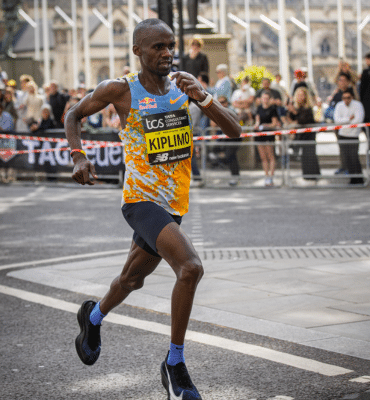
At 30km, Sabastian Sawe surged to 13 minute 5km pace, and Yomif Kejelcha was right there with him. Jacob Kiplimo on the other hand, last year’s second place finisher, was not. The reason he wasn’t, is that not only were all three back on world record pace, but Sabastian Sawe and Yomif Kejelcha were now also circling sub-2 territory.
Yomif Kejelcha pushed Sabastian Sawe almost all the way to the finish. And even though he lost his grip over the last kilometre, perhaps that was what the sub-2 hour barrier needed. The power of tough competition to send it crashing down. Not wind-shielding pacemakers, not custom technology, just racing in its purest form.
A(nother) marathon debut to remember
Let’s not forget. Sabastian Sawe may have become the first man to ever legally run a sub-2 hour marathon when he defended his London Marathon title in 1:59:30, but Yomif Kejelcha was right there behind him. On his debut. The fastest ever marathon debut because it’s almost impossible for it not to be. He went straight to 2nd on the all-time list just like his female compatriot Fotyen Tesfay did earlier this year in Barcelona. London Marathon has seen its fair share of impressive marathon debuts. Yomif Kejelcha’s trajectory echoes that of Sifan Hassan, another former track athlete and former mile world record holder just like Kejelcha was indoors.
The only difference is that when Sifan Hassan made her marathon debut in London 3 years ago, she won. And with 1:59:41, at any other time and in any other race Yomif Kejelcha would have and should have won. But Sabastian Sawe completely changed the game yesterday. Jacob Kiplimo’s 2:00:28 for 3rd place, also under Kelvin Kiptum’s previous world record of 2:00:35, will never it get its dues. Because it was 58 seconds too late to ever be considered unbelievable.
London Marathon Men’s Podium:
- Sabastian SAWE (KEN) 1:59:30
- Yomif KEJELCHA (ETH) 1:59:41
- Jacob KIPLIMO (UGA) 2:00:28
A new era for the marathon
The London Marathon has always been known for breaking records. For the highest number of participants, for the fastest marathon run in crocs, but never this. This year was something else. The sub-2 hour marathon was once thought impossible, or only possible with outside help, yet here it stands very much real in front of us. In his prime, Kelvin Kiptum was 36 seconds away. That’s less than Jacob Kiplimo took off his personal best yesterday, and he didn’t break 2 hours. The simple fact that the number in front changes from a 2 to a 1 suddenly makes a running big personal best impossible? It’s not just a time barrier that was shattered yesterday, it’s a perspective.
Written by- Rosana Ercilla

