





After dangling it like trail-running candy at UTMB, the Brooks Cascadia Elite has finally landed in stores across the globe. Brooks is jumping into the trail super-shoe arena with an exciting plated racer built for speed. The midsole pairs Peba foam with a plate meant for quick, efficient transitions.
Chances are, you’ve already read a review or two of the Cascadia Elite somewhere on the web. On paper, this one is aimed squarely at elite runners chasing podiums. But the real question for most of us common mortals who still want a fast, confident shoe over long and ultra distances, is whether all that race day tech could also give the middle of the pack trail runners an edge.
Keep reading to find out whether or not this shoe added value for our team of non elite trail runners.
Upper and Fit of the Brooks Cascadia Elite
What works for me
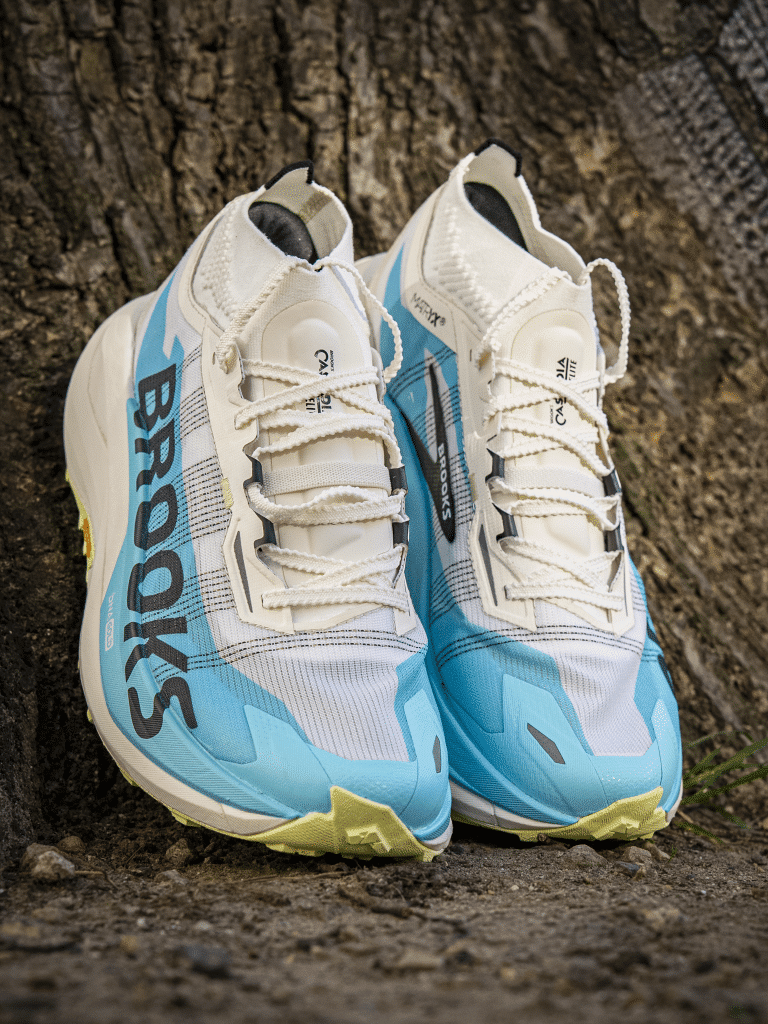
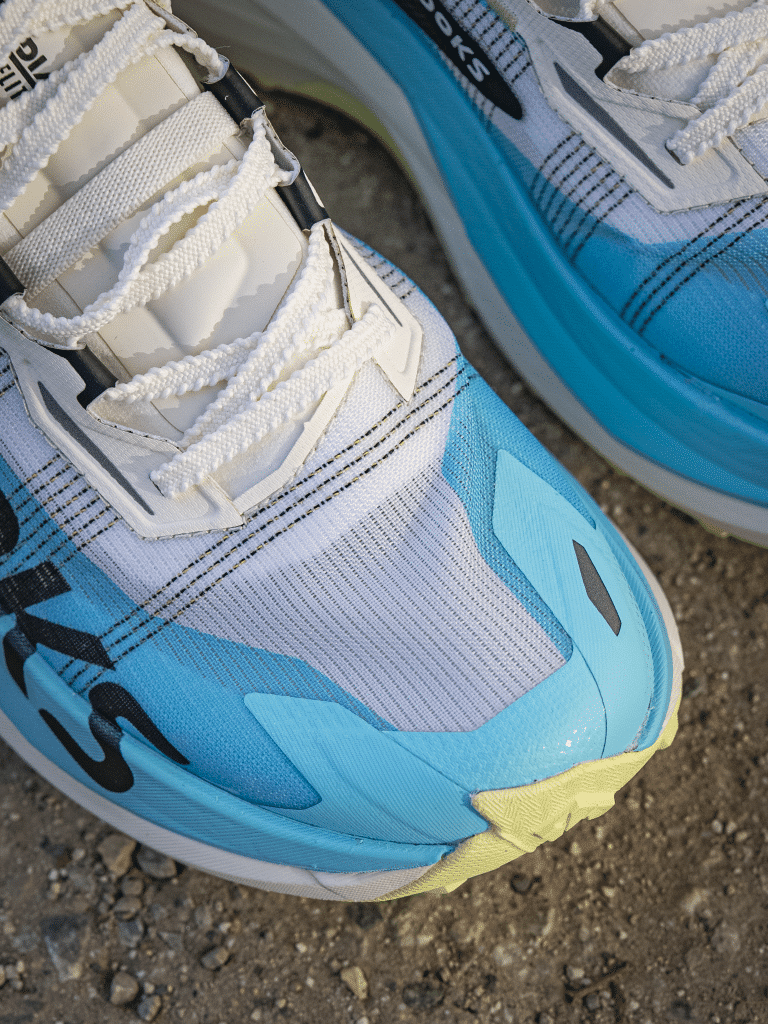
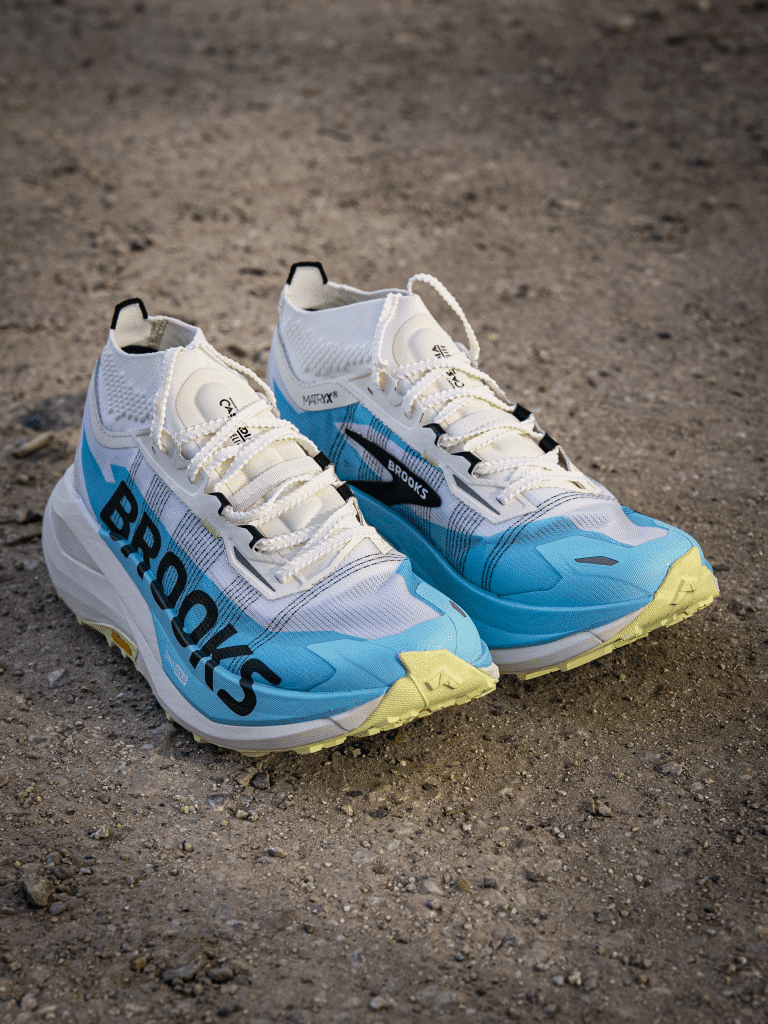
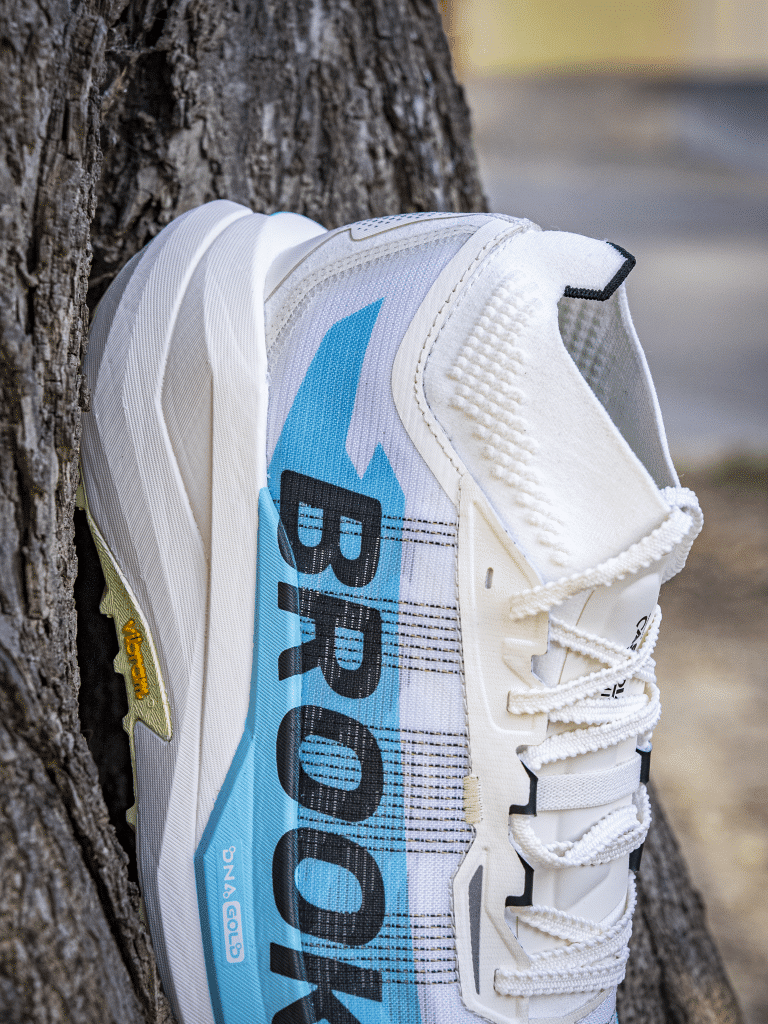
After its sexy look, the Cascadia Elite stands out for how thoughtfully its upper was designed. The upper is light and loose in its materials where the foot needs to be accommodated, while nicely holding it in place nestled inside a bucketseat. This is a welcome change where other Brooks models might have promoted plush comfort and a relaxed fit. Here, a breathable Matryx fabric wraps the entire foot, reinforced with a Kevlar cross-weave that adds structure when lacing up. The result is a dialed-in fit without suffocation. A light and airy feel while still being very protective.
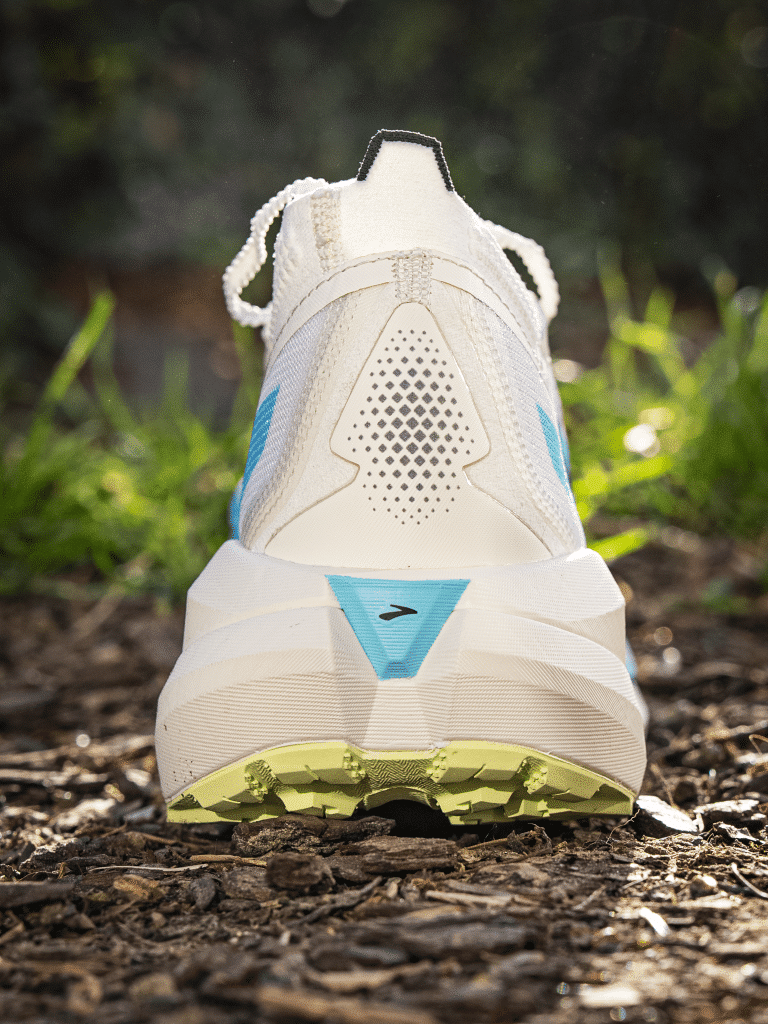
Putting the shoe on, you’ll notice a bootie style construction creating a secure and comfortable hold right from the start. It also limits debris from entering the shoe. A sock-like collar is a hard thing to get right. It’s usually either too constricted or too loose to do its job properly. I think Brooks has done a great job here with a soft fabric that avoids the panic attacks we had before starting a race in Salomon shoes and couldn’t get the darn shoe on without cutting off circulation to the fingers. The Cascadia Elite avoids that mess with its soft fabric, which slips on almost like a hug. If anything it’s the seam where the heel cup meets the bootie collar that took some getting used to but this faded away for me over time.
Brooks has added zonal padding on a tongue that doesn’t constrict the foot even when cinching laces really tight. Peeking inside the shoe, small steristrip-like reinforcements appear in key areas. These subtly add durability and hold where they would perhaps have appeared as overlays outside the shoe in other Brooks models. The heel is the only place where you’ll find plush padding. Everywhere else the focus is on breathability, lightness and drainage. Ribbed race laces complete the setup and can be tucked neatly into the lace band.
What doesn’t work for me
The upper is pretty epic on this shoe. If I could be picky, I would have liked to see a women’s fit on this unisex shoe to accommodate a more curved footshape and less foot volume.
Midsole and Ride of the Brooks Cascadia Elite
What works for me
The Cascadia Elite is a trail super shoe. It is bursting with tech for more energy return, efficiency and quick transitions on the trail. We’re looking at a shoe with a stack of 40mm in the heel, 34mm in the forefoot for a playful 6mm drop.
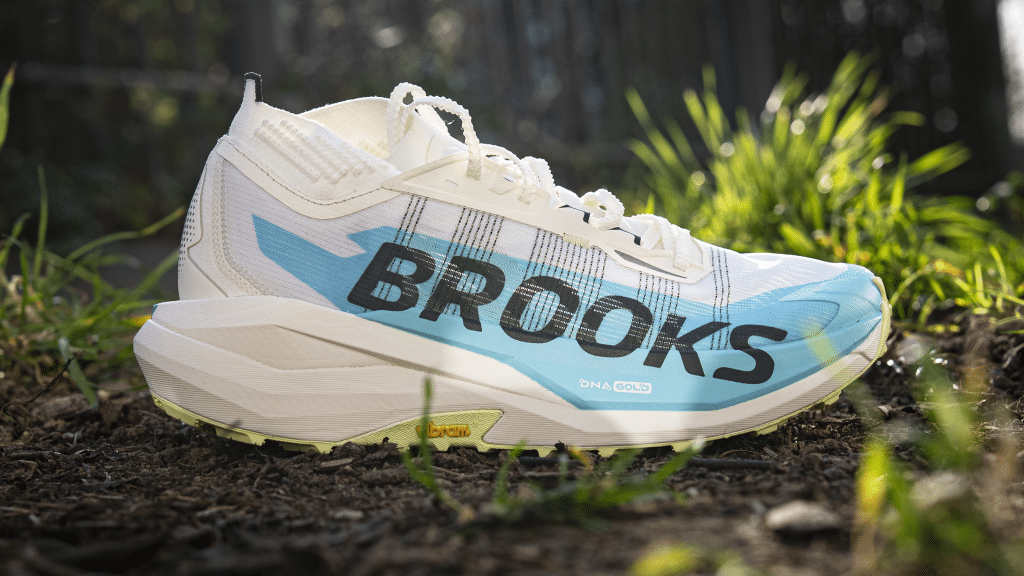
Brooks sandwiches a horseshoe carbon-infused Pebax Speedvault+ plate here between two thick DNA Gold (100% Peba) layers. The result is a plate that you can’t really feel underfoot while keeping the sole nice and pliable. The plate adds good control rather than propulsion to what otherwise might have been a smooshy, squirly ride. Do trail shoes need a plate? Maybe not normally, but when there is 40mm of highly squishy foam underfoot, it’s nice to have some structure underfoot. For fast paces, it’s welcome control. On descents, fireroads and straights, the turnover was smooth like butter. It’s that feeling you get from a premium road shoe.
The increased energy return of this midsole is even more noticeable at faster paces, when you are applying more force. You still get a nice cushioned ride at all paces and all footstrikes but the DNA Gold benefits were more apparent on tempo trail runs. Imagine the bounce of a toddler vs. an adult on a trampoline. The more force applied, the more it gives back.
What doesn’t work for me
I tried to push the paces on shorter runs with a good incline in this shoe and I can’t say that the plate gave me any advantage on the uphill. On 4×4 hill reps, I actually lacked agility underfoot given such a wide platform. In that sort of session I found the high stack to be overkill, where I’d have appreciated a lighter and more agile fast racer, think Brooks Catamount series or ASICS Fujispeed 4. On longer runs, it excelled, helping me when my form suffered. After two hours on the trails, this was the shoe keeping my legs turning. Let’s remember what this shoe was clearly designed for, and that is long endurance running.
Outsole of the Brooks Cascadia Elite
Grip and Traction
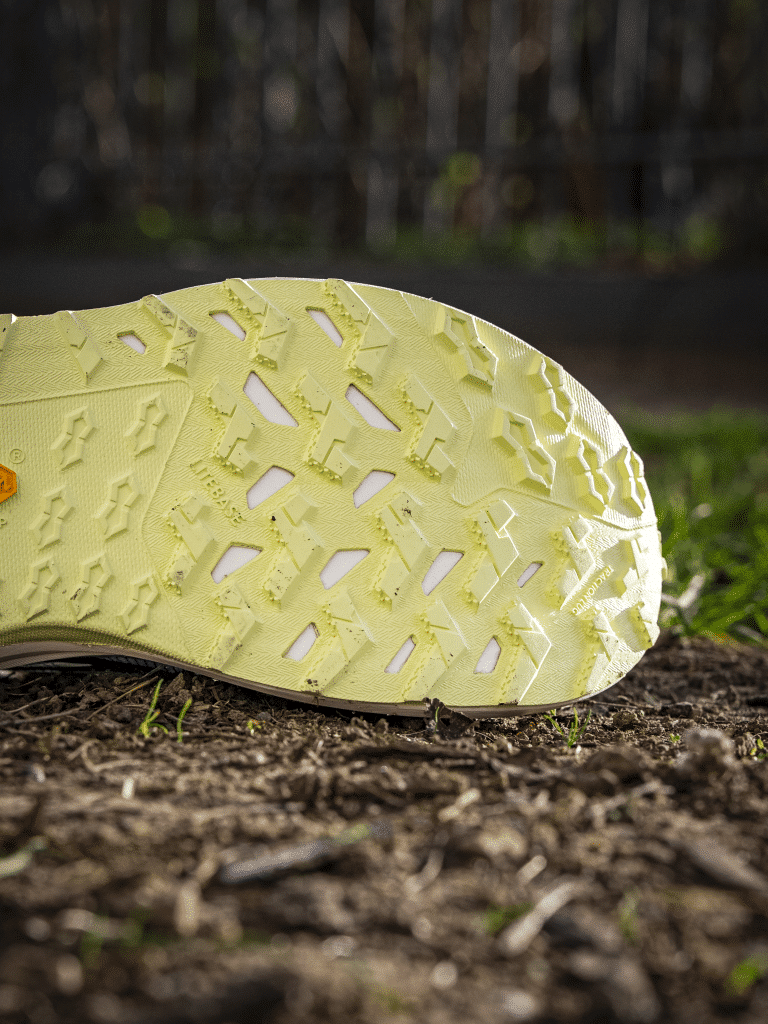
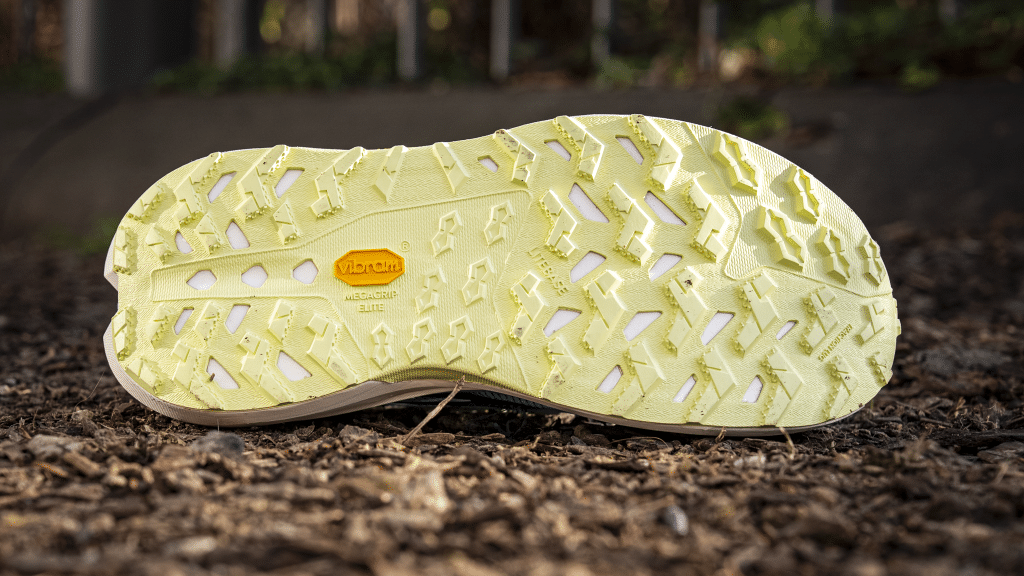
The outsole is pretty special on the Cascadia Elite. We all know Vibram Megagrip. This was my second only experience with a Vibram Megagrip Elite outsole after testing the norda 005. On both shoes, there’s that unmistakable suction sound on pavement reminding you to keep it on the trails where it will reward you with a good dose of confidence. If you don’t, it will punish you with sanded down lugs.
The full-length Megagrip Elite compound really delivers exceptional adherence to roots and rock, whether dry or wet. At 3.5mm, the lugs feel a little shallow to me, even with little spurs for extra traction. That’s probably good enough for an elite, but left a lot to be desired in muddy terrain where I felt myself slipping around. I could see this shoe shining on a long dry race with moderate technicality like a UTMB or Leadville 100 course.
Durability
I won’t speak to the durability of the Cascadia Elite until putting it through a few ridiculously long efforts. That said, DNA Gold found in Brooks road shoe line-up has held up really well for me as have all of the uppers in the many Brooks shoes I own. The Kevlar cross-weave should add to that durability. The only caution would be underfoot on those lugs over time. Overall, an exciting shoe with promising durability.
Conclusion
Value for Money
At €250, the Cascadia Elite carries the pricetag of a high-end road shoe. Brooks isn’t just trying to offload an expensive trail shoe onto casual runners though. This is a premium, performance product, designed for long race days and built for versatility. Every detail reinforces that positioning: from the innovative carbon plate to their best-in-class DNA Gold foam, all wrapped in a supportive Matryx upper.
If you’re chasing a podium, this shoe is definitely worth considering. For midpack runners, the price may feel steep, but put it in perspective: the Hoka Mafate X daily trainer, was going for €225. For just €25 more, you get a shoe that’s not only highly versatile for training and racing, but also both comfortable and responsive underfoot, with a much lower risk of rolling an ankle.
Fitting it into a shoe rotation
If you’re truly a common mortal without deep deep pockets, this will be your race day shoe rather than your daily trainer. With the special peppy midsole upgrade Cascadia 19 received last year, Brooks showed us that daily training can actually be fun. Sure, the Cascadia Elite can handle occasional training miles when you want to mix in some speed or get a feel for the plate. But mainly it’s that special shoe for your A-race. For shorter efforts, a VK or a highly technical race, you’ll want to reach for something nimble in your arsenal for faster, shorter days. The Catamount 4 is perfect to scratch that itch.
Final Verdict
The Brooks Cascadia Elite is poised as its all-star trail supershoe, rewarding the head of the pack. However, I’d venture out to say that you do not need to be on the podium to enjoy it. That is, if you are aiming for speed. It delivers confidence and stability if you’re looking to perform on moderately technical trails. This is thanks to a responsive midsole that rewards each push-off and an upper that holds the foot securely without restricting movement. It’s going to guide your foot when your form has long failed and cushion where you need it over long distances.
This is not one for muddy paths or short trails, but on longer endurance races, it excels. Save it for race day or long runs, and it will provide durable performance, comfort, and a boost of confidence that makes you feel like you belong among the elites even if your name is not on the favourites list.
If you are ready to invest in a premium trail racer that inspires trust and speed, the Cascadia Elite lets you run like an elite even if you are not chasing a podium.
Comparisons Against Similar Shoes
Brooks Cascadia Elite vs. norda 005
Both the Cascadia Elite and the norda 005 are premium race-day shoes using high-end materials. The norda 005 is noticeably lighter (by around 30 grams in my size). It’s more nimble too, providing a responsive ride suited for fast paces on more technical terrain. Both feature excellent Vibram Megagrip Elite traction. Their heel-to-toe drops are similar: the 005 at 7 mm and the Cascadia Elite at 6 mm. In terms of price, the Cascadia Elite is slightly more accessible at 250 euros. Meanwhile the norda 005 is significantly more expensive, offering cutting-edge materials and a highly locked-down fit system designed to handle multiple race days. Overall, I’d say that the Cascadia Elite prioritises stability and long-distance confidence, whereas the norda 005 leans toward speed, agility, and technical performance.
Brooks Cascadia Elite vs. Hoka Tecton X3
It’s delicate to compare shoes that come out in different years yet the Tecton X3 and Cascadia Elite are very reminiscent of one another. They share similar ambitions for performance on the trails, for Matryx bootie-style uppers and plated PEBA midsoles. Tecton X3 is that snappier shoe with a smoother toe-off, a 5 mm drop, and more aggressive lugs, ideal for fast, technical runs. The Cascadia Elite offers slightly more cushion, a 6 mm drop, and shallower lugs on a Vibram Megagrip Elite compound, making it arguably more comfortable over long distances. Prices at release were identical for both shoes at €250. You’ll probably be able to knock a good €50 off that for the Tecton X3 at this time of publication though.
Other People’s Takes on the Brooks Cascadia Elite
Raoul’s Take on the Brooks Cascadia Elite
This is THE hype trail shoe of 2026. The thing with hype is that it often creates an unrealistic expectation (Google Glass, Windows Vista, Hoka TenNine) about performance for the masses. The acme of performance is also not where the majority of runners find their performance level. How does a brand like Brooks create a shoe that can win UTMB, WS100 and help Joe Bloggs conquer their first trail ultra without letting the market down?
The aesthetic of this shoe is total eye candy. It feels premium straight out the box, before it’s even on the foot. The bootie construction is the definition of ‘as little design as possible’ in that it is easy to get on and then I forgot about it entirely unless I looked at the shoe. The zonal padding on the tongue… perfection. The heel padding? Like a hug from a long lost friend. Tidy laces that stay tied. The upper overall… exceptional.
Which is not even the best part of this shoe.
Trail supershoes are plated because without the plate, the soft foams would make the shoe a complete nonstarter. They create stability and energy return later into long efforts. More recovery during, to be relatively faster at the end. If races are decided in the back 1/3rd of the event, this shoe is meant to shine there and then. The Cascadia Elite midsole gives a dense ping underfoot, much like my Puma Deviate Nitro Elite 4 feel on the road. It is not a soft ride, but oh my is it a lot of fun. The DNA Gold sings on the flat and downhills and while not as much fun as the On Cloudultra Pro on the ups, it is a more stable shoe everywhere else.
The Cascadia Elite midsole is stable in steep, loose singletrack sections, both up and down. There is not too much propulsion from the plate. This means no Bambi legs coming down techy stuff when tired, which I have had in other trail supershoes. Brooks have balanced the midsole to give the biggest difference in areas where you can run fastest. This is a similar execution to the Hoka Tecton X, which I believe is 100% on purpose. Trail supershoes are not uphill specialists. They are too bulky, period. Trail runs and races are a mix of terrain and the Cascadia Elite shines where it matters.
The midsole begs you to be fitter than you are. The back end of any run is better in this shoe due to the stability and ride of the shoe as a whole. It wants to keep going, even when you cannot.
The outsole is a Vibram Megagrip Elite piece of art. Sure, the lugs are shallow and running on any sort of tar with it will sand down the lugs faster than you can count the euros it cost you per kilometer. Who cares when the going is this good where the shoe was meant to shine – out on dry trails. Peanut butter in a mohair carpet traction is extremely confidence inspiring and I only hope that Vibram outsole replacement companies will have access to Elite outsoles in the (hopefully not too near) future.
THE hype trail shoe of 2026 delivers. In spades; in every department that counts; in the scenario it was designed for (winning races in the back 1/3rd of the day). Does it deliver for €250? I believe it absolutely does. Considering the creep of regular training shoes over €200 recently, for €50 extra you get so much value.
Is the shoe for elite athletes only? I am no elite and I cannot wait to train and race more in this shoe. Would I recommend it to runners just starting out? No. This is a shoe for more experienced runners, not necessarily elite runners. I agree with Esther that this is the ideal long run / race day shoe. A premium trail racer that inspires trust and speed. Word for word, I whole heartedly agree and am already excited to take the Cascadia Elite out for a long run this weekend.

