


SCOTT caught us off guard in January with the light, peppy Kinabalu Trail. It came as a dark horse that quietly stole the fun-run crown. SCOTT has just announced the arrival of its max stack cruiser companion, the all-new SCOTT Kinabalu Ultra.
Can SCOTT translate that lively ride from its agile trail shoe sibling into the ultra-distance category? And who exactly is this shoe best for?
To find out, our trail team tested the Kinabalu Ultra across three countries and a spectrum of terrain: from hard packed dirt to wet, technical trail. Here’s where it shines and who it’s truly built for.


Upper and Fit of the SCOTT Kinabalu Ultra
What works for me
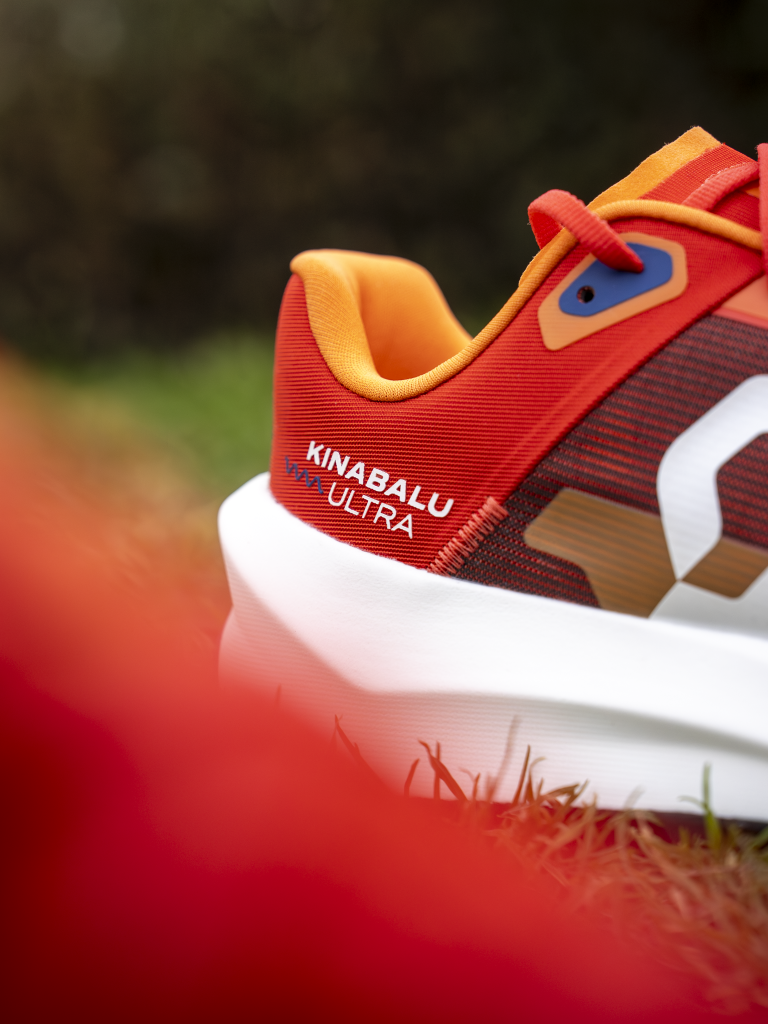
Tasteful colour palettes meet solid materials to create another design wonder out of the Swiss SCOTT HQ. Honestly, whatever’s happening in that color lab lately – keep it coming. Every colourway is a knockout. In terms of design, the upper on this shoe is rather reminiscent of the Salomon Genesis. A breathable but bulletproof Matryx upper wraps over the foot and a reinforced external toe bumper provides good protection. The tongue is thin but reinforced where needed and doesn’t budge thanks to anchoring wings. A perfectly padded heel counter reminds you that we’re trying to shed weight here. My pair came in at a shocking 212gr (US size 6).
If the Kinabalu Trail had a precision fit, the Ultra turns the dial even further. It almost makes the Trail feel relaxed. The Kinabalu Ultra is unapologetically snug. I happen to love this fit. If you’re blessed with narrow feet, this is your Cinderella moment. That luggage cling-flim wrapping at the airport couldn’t have done a tighter job around your suitcase! The upper embraces your foot all the way around, with just enough forgiveness from the Matryx fabric to keep things comfortable when the miles stack up.
Note that the women’s version comes with a more sculpted insole, likely to espouse higher arches. An appreciated detail.
What doesn’t work for me
Whereas some long-distance shoes will have you nestled into the foam bed for added stability, the foot sits on top of the midsole here. It’s like this shoe was built from the ground up like an apartment block. If you are a neutral runner with tidy mechanics, that’s fine. Even better if the terrain is light, think buffed out trail or riverside running.
However, that instability is more noticeable on uneven ground. A slightly more built-up heel collar might have helped limit medial movement and added a touch more security in those moments. In the meantime, I used that last eyelet to add some foot hold. This additional tension may have contributed to some strain along the stitching where the heel collar meets the Matrix upper on my pair.


Midsole and Ride of the SCOTT Kinabalu Ultra
What works for me
The Kinabalu Ultra midsole is a Kinetic Nitrogen infused foam. It feels cushioned and protective but it’s definitely not squishy. What you get is a more dense, muted ground feel that still protects your foot from the elements. As a heel-striker, I appreciated an added cushioning under the heel. Great news on the foam durability side of things: I am not having the compression concerns I had with its agile Kinabalu Trail sibling. The midsole foam is simply looking that much more durable.
The ride is fairly predictable with acceptable energy return. I see it as a shoe with good vertical bounce and moderate forward assistance. That said, the combo of a 7mm drop, a late rocker in a light overall package keeps the foot moving nicely on this shoe.
What doesn’t work for me
I found that the Kinabalu Ultra didn’t show a whole lot of flexibility over major terrain variations. Running uphill in gradients in which you need to be on your toes, I noted some heel slippage. The whole outsole platform seems to work as one firmer unit giving too much heel lift. In addition, the lack of a “bucketseat” design resulted in some instability on rockfall and roots.
Maybe it’s just semantics but I would have called this the Kinabalu Max rather than Kinabalu Ultra. Reframing this as a max-stack shoe rather than an ultra shoe made perfect sense to me. You’ll get lots of mileage out of this bad boy, particularly on more buffed out trails rather than attempting a mountainous ultra with it.
In fact, the ride on this shoe reminded me somewhat of the Hoka Mafate X: it’s that solid tool for pounding out longer training distances on less profiled terrain.


Outsole of the SCOTT Kinabalu Ultra
Grip and Traction
The Kinabalu Ultra features SCOTT’s proprietary outsole with approximately 4.5mm lugs, with outsole rubber running the full length of the shoe. This is a welcome move for long-haul durability. There’s also a central decoupling groove designed to help the platform adapt to uneven terrain. I can’t say I felt that feature at work, but the overall ride remained smooth and consistent.
In dry conditions, the outsole performs confidently. On hardpack, gravel, and typical dry trail, traction is solid and predictable – exactly what you’d want from a max-stack distance shoe.
In wetter, muddier conditions, the closely spaced lugs can take a moment to shed debris before regaining their full bite. For runners regularly navigating saturated or highly technical terrain, a different aggressive lug pattern might have offered quicker mud clearance. That said, in moderate conditions, the outsole strikes a sensible balance between grip, durability, and efficiency.
To be fair, the Kinabalu Ultra isn’t trying to be a fell-running specialist. It feels built for distance on lighter trail terrain.
Durability
At just about 100km we’re still early in the game but the midsole foam is showing little to no compression. I’m thrilled about this. The outsole rubber too is holding up perfectly. And that Matryx upper is as always remarkably abrasion resistant. The only note so far is some minor stitching fray near the heel collar on my pair. That said, none of our other testers have reported similar issues, which may suggest this could be an isolated early-production quirk rather than a broader durability concern.
Conclusion
Value for Money
At €170, I think that SCOTT has hit a sweet spot given that this is a longer-distance shoe with promising durability. The shoe fits right around that Hoka Speedgoat 7 price point.
Fitting it into a shoe rotation
A lean but wonderful trail specific rotation would be to use the Kinabalu Ultra on your longer or slower trail days and the Kinabalu Trail on shorter, faster trail days.
It would also be a lovely longhaul rolling hill shoe to have alongside a more technical terrain longhaul shoe.
Final Verdict
The Kinabalu Ultra feels intentional. Every design decision points toward efficiency: lightweight build, precise upper, durable materials, and a platform tuned for steady, long-distance rhythm rather than technical chaos.
It won’t suit everyone. But if you have a narrower foot and are looking for a reliable, European style shoe for smoother trails, the Kinabalu Ultra gets the job done. It’s refreshingly light for its stack, durable where it matters, and snug in a category that can sometimes drift toward overbuilt, slouchy comfort.
Comparisons Against Similar Shoes
SCOTT Kinabalu Ultra vs. SCOTT Kinabalu Trail
The Kinabalu Trail and Kinabalu Ultra share the same DNA. Both have a precise fit, low weight and durable constructions. But they live in different lanes. At €150, the Trail is a playful one: lighter on stack, quicker to turn over, built to make 10–20km feel electric. The Ultra stretches that blueprint into the long-distance realm, adding protectiveness and durability.
SCOTT Kinabalu Ultra vs. HOKA Mafate X
Both of these two were designed for long runs at cruiser pace. Yet the Kinabalu Ultra and Mafate X approach the max-stack, long-haul mileage brief from opposite ends of the spectrum. Where the Mafate X is plush, stable, and unapologetically cruiser-focused, the Kinabalu Ultra is lighter and much more snug. The Kinabalu Ultra will keep a whopping $50 in your pocket for runners who don’t need a plated trail shoe… or pizza lugs… on their next long run.
Other People’s Takes on the SCOTT Kinabalu Ultra
Raoul’s Take on the SCOTT Kinabalu Ultra
Girona is littered with buffed trails but has experienced a LOT of rain this year, so I was pretty amped to run in this shoe on home trails to test it in all conditions. The shoe is lightweight and its aesthetics are top-drawer. Despite its midsole degradation, I have truly enjoyed the Kinabalu Trail for its minimalistic approach. Can the Ultra deliver where the Trail was so close to being amazing?
The sock-like upper on the Kinabalu Trail gave me big smiles and the upper on the Ultra is nearly identical in fit and works with my feet perfectly. If all trail uppers were identical to this, I would be one happy human. The upper is a true definition of minimalism, where ‘as little design as possible’ is the outcome. Dieter Rams was famous for this approach and it requires a lot of good technology and careful design to come to an upper this good with there being so little there. Chapeau!
Like Esther, I am also extremely happy that the midsole is not degrading as quickly as the Trail. It has yet to lose the decompression ‘pop’ and I constantly have to tell myself to slow down in this shoe when using it on recovery runs. The midsole is stacked and there is no bucket here, resulting in a few hairy moments on rooty trails. Thus felt more geometry related than stack related for me, perhaps related to the foot sitting so high on top of the midsole. The midsole does not give the shoe the feeling that it is on rails, but in 90% of conditions it is reliable, comfortable and fun. It is one of the few midsoles I have tested without a lot of pre-installed creases, so it will be interesting to see where they appear in the medium term.
The outsole has seen a lot more mud than is typical in Girona with an extremely wet January. In saying that, the Ultra has been surprisingly good. It is not a mud shoe, but sheds mud fairly well for an everyday shoe. The lugs are just deep enough to help. I have run in better and worse when it comes to mud shedding. For those who live in mostly dry areas, the Ultra’s outsole is an everyday winner and a reliable solution.
The Kinabalu Ultra is a stacked trail shoe for everyday running that is good almost everywhere, making it a compelling solution in an already choc-a-bloc full segment of the running shoe market. Scott have created something for almost everyone. I look forward to many good miles on this shoe.
Theo’s Take on the SCOTT Kinabalu Ultra
What I mainly appreciate about the upper of this shoe is the lightness and the robustness of the Matryx mesh. It is a shoe made for the performance so it is really minimalistic but I love it. There is some foam on the tongue to protect the forefoot during the downhills. Laces are very very pleasant and comfortable also. The toe protection is minimalistic but it does a decent job.
While the shape of the upper on the Kinabalu looks pleasing,I found it too “square” and not rather contrary to the shape of my foot. In fact, I got some blisters on my toes after a few kilometres. Furthermore, the fit is quite narrow as Esther says. This is not a shoe for wide footed people. Similarly, as Esther found, running uphill led to slippage in the heel. No matter how I laced it up, they slipped. This was my biggest disappointment in the shoe.
The foam offers a lot of cushion, nonetheless, I am not sure I would do an ultra in the SCOTT Kinabalu Ultra. This is because they are still quite firm and so demanding on the calves. Also, I found the ratio between the stack and width of the midsole not really appropriate for being stable on technical terrains. Indeed, the stack is super high and the midsole quite narrow which is not ideal for ankles on roots and rocks.
As is traditional for SCOTT, the grip and traction are absolutely outstanding! It is definitely the strong point of these shoes. They never betrayed me on uphills or downhills. Despite what Esther found, I think there is absolutely nothing to change on this outsole.
I would use these shoes on long runs training and easy trails. Especially in rain and bad weather in particular because I will be confident in the grip. I would also use them on trail tempo runs because of their responsiveness.
Although the Kinabalu Ultra are not my favourite shoes, I found them quite enjoyable for their lightness and responsiveness. To be a real ultra shoe, I would love SCOTT to add still more cushioning and a wider midsole to really add stability. Also, I think a wider upper would be ideal to gain comfort for the toes and avoid blisters or/and black nails on ultra distance runs.
