






Some shoes arrive shouting. Carbon this. Plate that. Energy return percentages that nobody asked for. Geometry so advanced it needs a LinkedIn profile. The Mount to Coast M1 does not feel like that kind of shoe.
After around 100km in the M1 across Girona and Cape Town, this has been a superb shoe for combining terrain. Road connectors, gravel, dirt, dry trail, mountain paths, smoother singletrack, slightly awkward descents — the M1 has handled a broad range of running without ever feeling like it is trying to convince me it is something else.
And that is what I like most about it. The M1 feels simple in the best possible way. A single, honest slab of foam. No plate. No aggressive promise of speed and no shoe geometry screaming at your calves. Just a well-executed trail shoe with a brilliant upper, an exceptional lacing system, a fun midsole and a proper Vibram outsole.
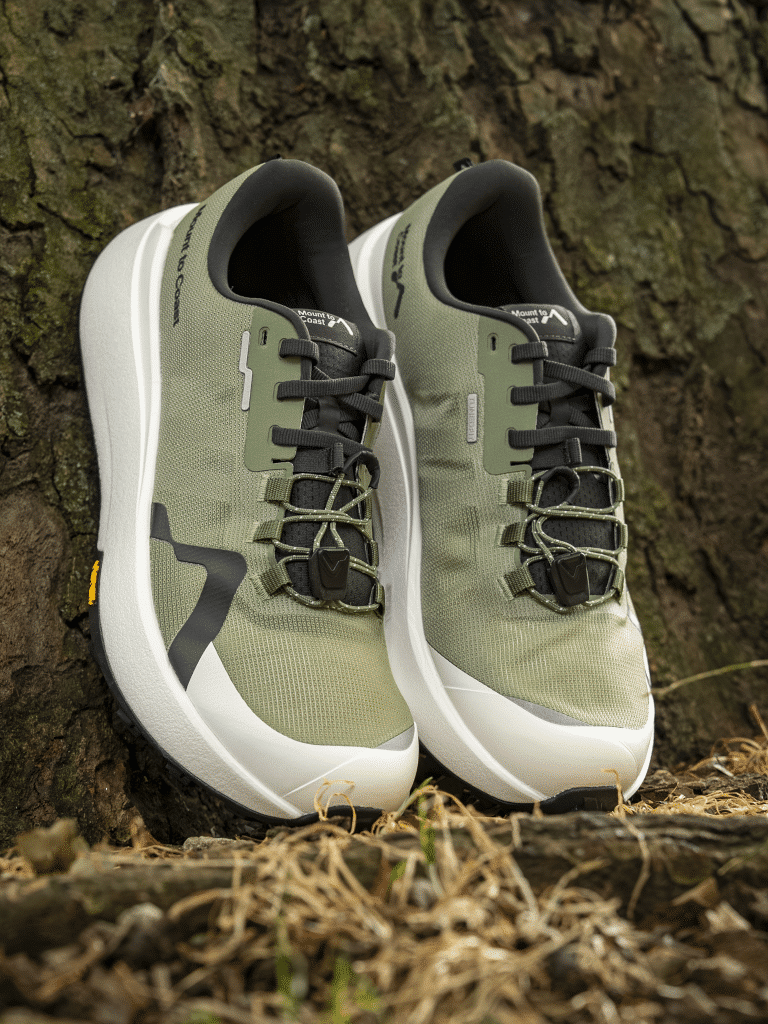
Upper and Fit of the Mount to Coast M1
What works for me
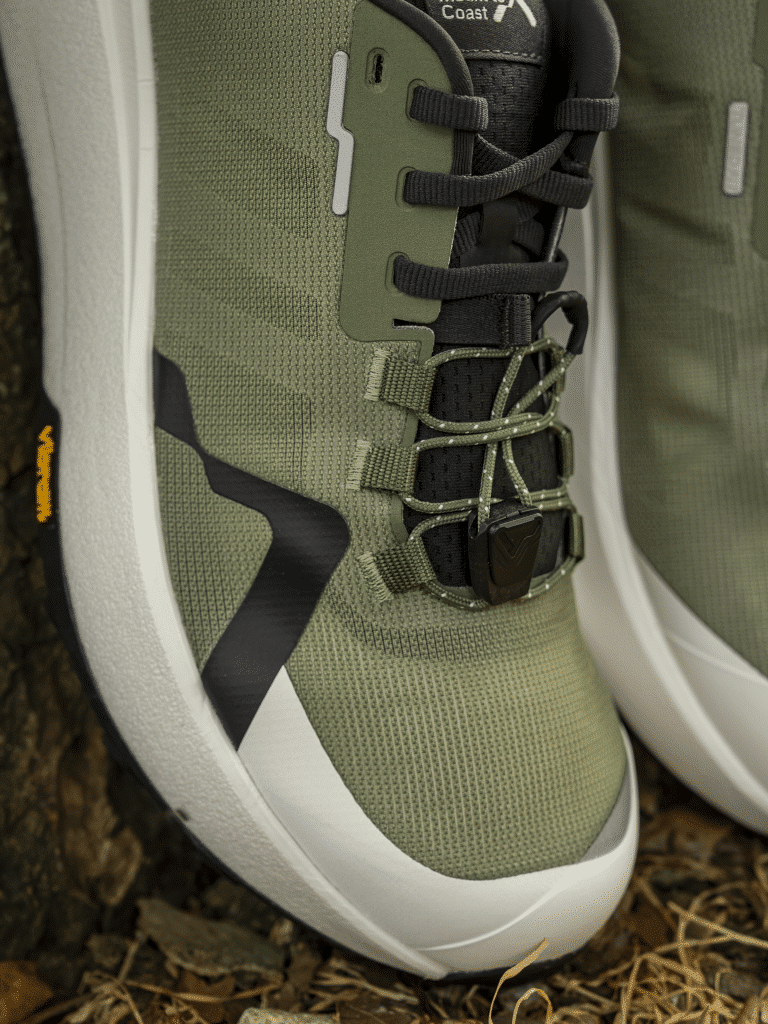
Let’s start with the headline: the TUNEDFIT™ Dual Lacing System is excellent. Actually, it being excellent undersells it. This might be the best lacing system I have had on my feet, period.
Mount to Coast’s system allows separate adjustment across the forefoot and midfoot, rather than forcing one lace tension to solve every foot problem at once. This is one of those ideas that feels obvious only after someone has done it properly.
I often find myself compromising with laces. Tight enough in the midfoot means too much pressure across the forefoot. Comfortable across the toes means not quite enough hold through the arch. The M1 removes a lot of that negotiation. You can secure the middle of the foot while leaving the front of the shoe more relaxed. This is exactly what I want on longer runs where feet inevitably start behaving like they have separate legal representation.
The result is a fit that is secure without being restrictive. That is a difficult line to walk, and the M1 walks it beautifully.
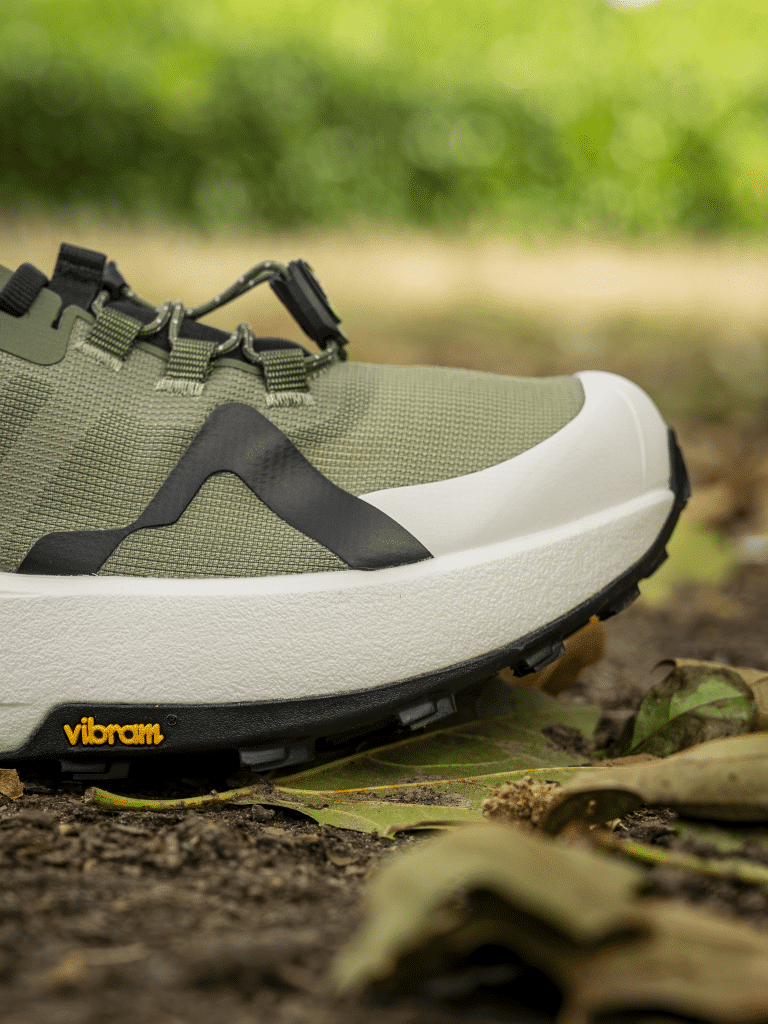
The upper uses TPEE-blended yarns, and the feel matches the shoe’s wider personality: comfortable, breathable and performance-oriented without being fussy.
For me, the fit is almost exactly where a long-distance trail shoe should be. There is space and air. There is no sensation of the upper trying to cosplay as a climbing shoe. Yet the lockdown is excellent because the lacing system does so much of the work.
This is not a narrow European racing fit. It is not sloppy either. It is a roomy, intelligent trail fit that understands feet get warm, tired, swollen and occasionally dramatic.
The upper works because it gives my foot space without giving it freedom to behave badly. The TPEE-blended yarns are breathable and comfortable, but the real hero is the TUNEDFIT Dual Lacing System. Being able to adjust the forefoot and midfoot separately feels like one of those things every brand should have been doing for years. It allows the M1 to feel spacious and secure at the same time, which is usually where trail shoe fit goes to die.
What doesn’t work for me
Annoyingly for a shoe tester, I have nothing of importance to add here. My only real caveat is that the fit is not a razor-blade race fit. That is not a criticism for the intended use, but it matters. If you want a narrow, hyper-precise technical shoe, the M1 is probably not trying to be that. It gives space, comfort and adaptability rather than compression and aggression. For me, that works beautifully. For some runners, especially on very technical terrain, it may feel too generous, feeling like a compromise in torsional reliability.
Midsole and Ride of the Mount to Coast M1
What works for me
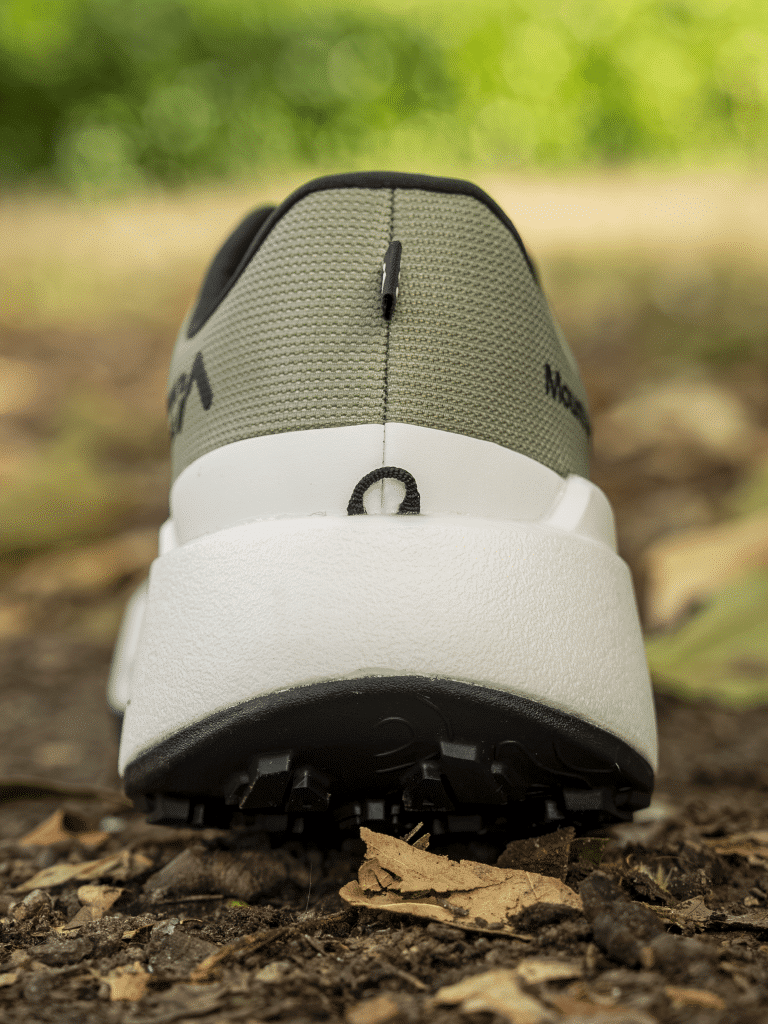
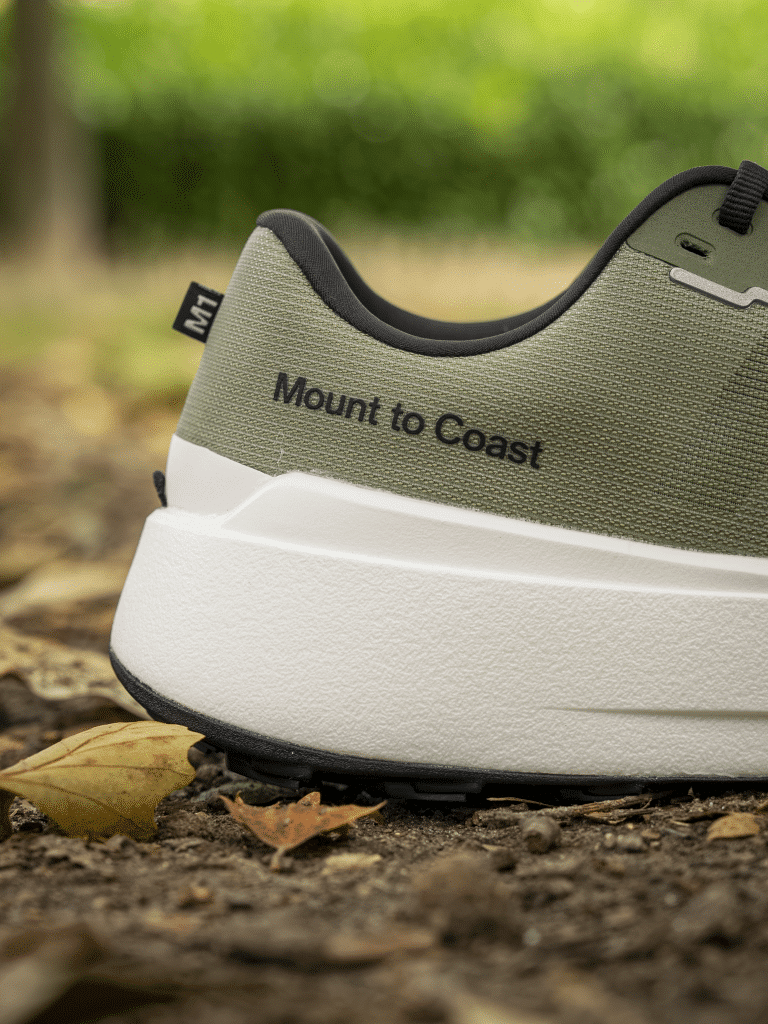
The M1 uses Mount to Coast’s JETCELL™ midsole, which the brand describes as its highest energy return foam, designed for consistent performance and, according to Mount to Coast, twice the material strength of PEBA.
The important thing for me is not the lab promise. It is simple. I love that this shoe feels like one coherent slab of foam rather than a sandwich of speed concepts. I am never waiting for parts of the shoe to ‘kick in’ if that makes sense?
No plate. No insert shouting at the stride. Nor strange disconnect between rearfoot and forefoot. No trying to work out which foam is carrying the other. Just a midsole that feels fun, forgiving and consistent across a lot of different terrain.
After around 100km, that simplicity has become the M1’s greatest strength. It is the sort of shoe that lets you change terrain without changing mood. Girona gravel, Cape Town trail, road connectors, dirt roads, rolling climbs — the M1 keeps moving without making the run about the shoe.
The 38mm / 34mm stack gives plenty of protection. The 4mm drop keeps the shoe feeling balanced.
You feel like you are sitting inside the stability of the M1, rather than on top of it.
This is a high-stack shoe numerically, but it does not feel like a wobbly maximal object.
The midsole is enjoyable without becoming unstable. It has enough response to make faster cruising feel good, but it does not punish you when you slow down. That is where the M1 separates itself from many plated or aggressively rockered shoes. It does not need you to run a certain way to justify its existence.
The M1 is a real Jack of all trades, master of most. Girona and Cape Town are not the same terrain. That sounds like an obvious thing to say, but some shoes do not travel well. They feel brilliant on one surface and confused everywhere else.
The M1 has been superb for combining terrain:
- Gravel.
- Dirt roads.
- Moderate singletrack.
- Road connectors.
- Climbs.
- Long rolling efforts.
- Mixed mountain terrain.
It has that rare ability to be interesting without being demanding. A lot of modern shoes confuse excitement with instruction. The M1 does not tell you how to run. It just lets you run. I have pushed this shoe on runs from 5km to 29km and the midsole just begs for more.
What doesn’t work for me
Another tough one to work out what doesn’t work for me. The midsole does have one clear weakness: root-laden descents and descents with a lot of short steps where the midsole often has to navigate being across the edge of a step. Very specific, I know.
When the trail asks for quick, repeated foot placements on terrain where there is a protrusion, the M1 midsole lacks the torsional requirement to navigate these obstacles. The foam is forgiving and fun almost everywhere else but here it feels too stacked and too blunt an object required. This is not a dealbreaker. It is category honesty. The M1 is brilliant across varied terrain, but it is not a low-profile technical scalpel. There are plenty of shoes for that.
Outsole of the Mount to Coast M1
Grip and Traction
I feel like every time we get the Vibram Megagrip Litebase Traction Lug (VMLTL) this section is mostly pre-written.
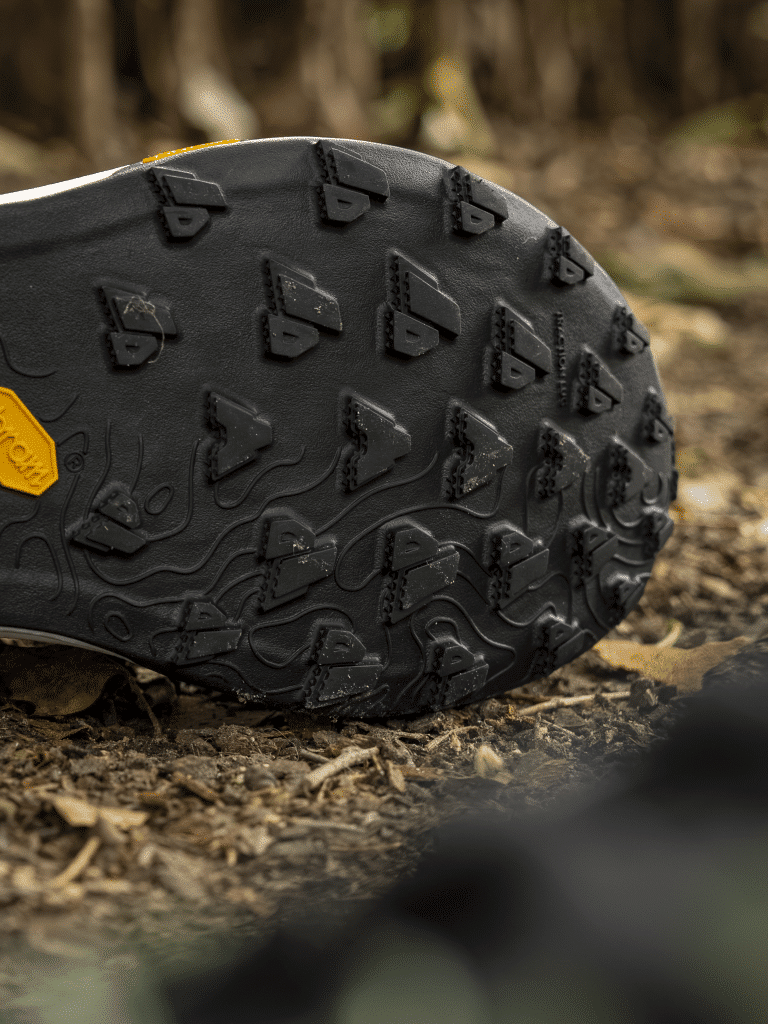
Saying that, the outsole is exactly what the M1 needs. Vibram Megagrip, Litebase and Traction Lug with 4mm lugs gives the shoe proper trail credibility without turning it into a tractor. It grips well enough for mixed mountain terrain. But, it still feels smooth enough when the route inevitably includes gravel or road connectors. This is a shoe built for messy real routes rather than perfect product-category boxes.
The lugs are spaced well enough for reliable traction in both the bone-dry Girona dust as well as the moist, snotty trails of Cape Town. I have set some fun PR’s down fast, technical trails here in Cape Town this week as the shoe really lends itself to a full send and not having to worry about the outsole slipping has been wonderful.
Durability
After around 100km, the M1 feels like a shoe that should age well. The Vibram outsole is the obvious confidence builder, but the simpler midsole construction also helps. There is no plate, no exposed carbon drama, no weird geometry that feels like it might become annoying once the foam settles. It is just a well-built trail shoe with good materials. What a concept.
I have managed to scuff a small piece of the collar off but this is not unusual for me, right where the cuff meets the inner ankle bone. The outsole is showing a few creases near the toes but nothing to worry about. The M1 will go the distance, in my opinion.
Conclusion
Value for Money
At €195, the M1 is not cheap, but it feels like good value in the current trail shoe economy. You get a premium Vibram outsole, a genuinely excellent lacing system, a strong upper and a midsole that works across a wide range of runs. More importantly, you get a shoe you can actually use often and will last a long time.
This is where the M1 makes more sense than many more expensive race shoes. It is not asking to be saved for one special day. It is asking to go running and will be there for you long after your supershoes are relegated to the bin.
Fitting it into a shoe rotation
In my rotation, the M1 becomes the shoe for the days where I do not entirely know what the run will become. I generally make my routes up as I go and the M1 is the perfect tool for this human. Girona and Cape Town both reward shoes that can handle variety, and the M1 has been superb for that. It can cruise gravel, handle technical trails, deal with road connectors and still feel good when the run gets longer than planned.
It is not the shoe I would choose for rooty, stop-start technical descending, and it is not the shoe for racing a vertical kilometre. But for mixed terrain, long runs and general mountain usefulness, the M1 is very easy to justify.
Final Verdict
The Mount to Coast M1 is one of those shoes that gets better the more I use it. This is because its strengths are practical rather than theatrical. After around 100km across Girona and Cape Town, it has proven itself as a superb mixed-terrain trail shoe with a spacious breathable upper, the best lacing system I have had on my feet and a midsole that is fun, forgiving and refreshingly simple.
I love that there is no plate. I love that the shoe is not constantly promising speed. Finally, I love that the midsole feels like one coherent slab of foam rather than a committee meeting of technologies. The M1 just works.
It is not perfect. Root-laden descents and short-step technical downhill running expose its limits. If you want a precision descender, look elsewhere. But if you want a versatile, comfortable, premium trail shoe that can handle varied terrain and long runs without making a fuss, the Mount to Coast M1 is excellent.
Simple done properly is still special.
Comparisons Against Similar Shoes
Mount to Coast M1 vs. Scott Kinabalu Ultra
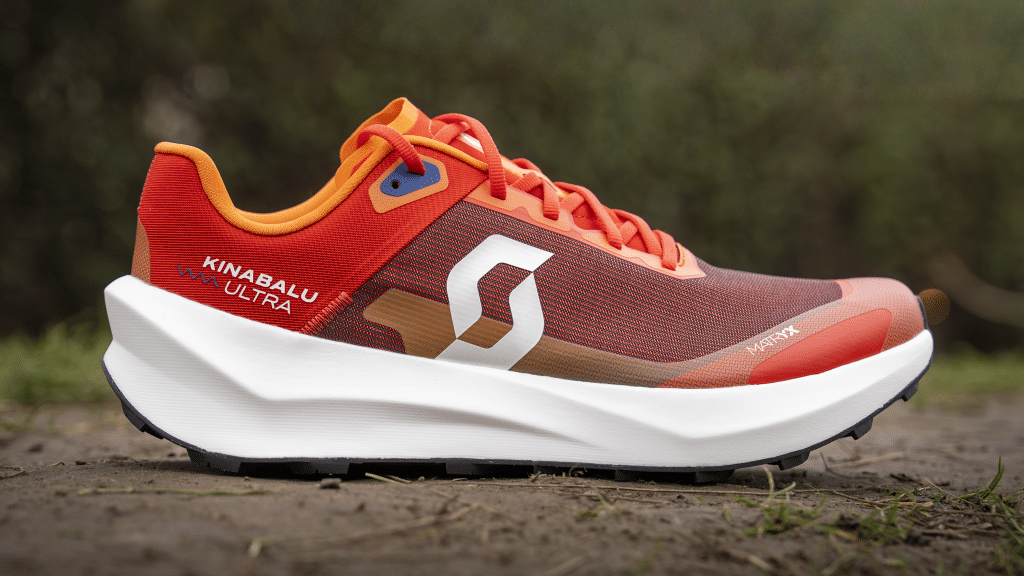
The Mount to Coast M1 and Scott Kinabalu Ultra sit in a similar emotional space for me. Both are shoes that make sense when the run is long, rolling, varied and not overly obsessed with being a carbon-plated theatre production. The Kinabalu Ultra has that very SCOTT feeling of smooth efficiency, with a light weight around 270g, a high-ish 40mm stack in the current version, and a design that wants to cruise for a long time without shouting about it. It is Swiss design in the best and occasionally most Swiss way: clean, efficient, quite serious and probably judging your sock choice. The M1, though, feels more modern underfoot. The JETCELL slab gives it a little more bounce and forgiveness. Meanwhile the TUNEDFIT Dual Lacing System gives it a far better fit solution for long runs where your feet start changing shape and making demands like tiny unions.
Where the Kinabalu Ultra feels like a long-distance trail shoe built around efficiency, the M1 feels like a long-distance trail shoe built around adaptability. The SCOTT is probably the cleaner option for steady ultras, rolling trails and runners who like a more traditional, composed ride. The Mount to Coast is the one I would take when the route is less predictable. Girona gravel into singletrack, Cape Town mountain paths into road connectors, long climbs into runnable descents. The M1 has the better outsole package on paper with Vibram Megagrip, Litebase and Traction Lug. The upper/lacing combination is simply excellent. Neither shoe is a technical descending scalpel, but the M1 feels more fun and forgiving across mixed terrain, while the Kinabalu Ultra feels more measured and steady. If the Kinabalu Ultra is the sensible long-run choice, the M1 is the one that makes sensible feel a little more exciting.
Mount to Coast M1 vs. ASICS Trabuco Max 5
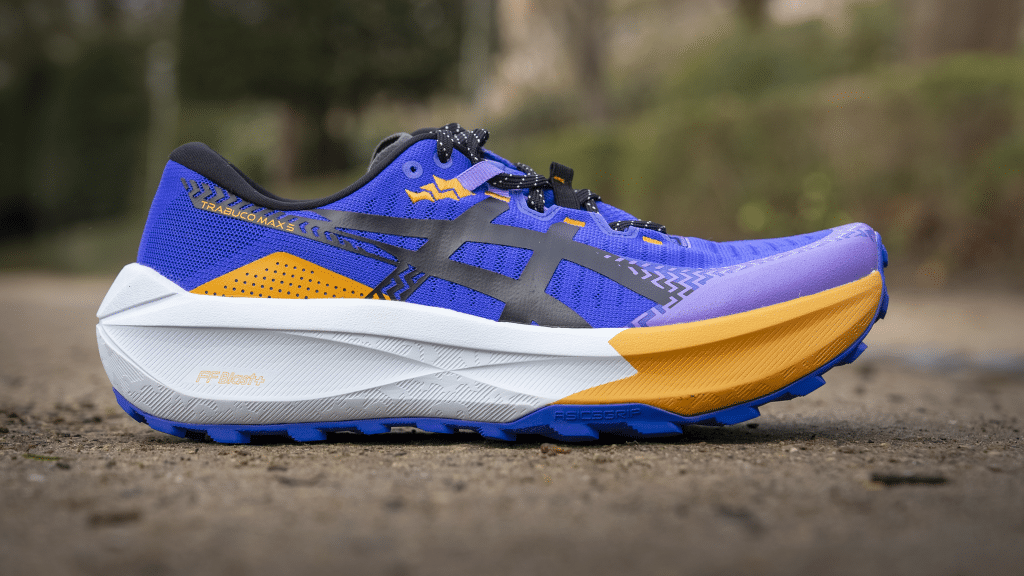
The ASICS Trabuco Max 5 is the more traditional max-cushion trail cruiser here. 40mm / 35mm stack, 5mm drop, FF BLAST PLUS foam, ASICSGRIP outsole and a general sense that it was built to protect your legs over long distances rather than make every kilometre feel lively. The Mount to Coast M1 is not massively lower at 38mm / 34mm, but it feels like a very different interpretation of cushion. The ASICS is firmer, more grounded and more protective in that big-shoe way. On the other hand, the M1 feels more fluid, more enjoyable and more natural through the gait cycle. I expected the Trabuco Max 5 to give me that bouncy max-stack “let’s just keep going forever” feeling, but it is more serious than that. The M1, oddly, is the simpler shoe and also the more fun one.
The biggest difference is personality. The Trabuco Max 5 feels like a durable, dependable, slightly dull long-run tool that will do the job without ever becoming the reason you are excited to run. The M1 feels more spacious, more breathable, better laced and more adaptable across mixed terrain. The TUNEDFIT system alone gives the Mount to Coast a significant fit advantage for me, while the single-slab JETCELL midsole gives it a forgiving ride without needing plates, inserts or geometry-based motivational speeches. The ASICS probably wins for runners who want a firmer, more conventional, protective max-cushion shoe and do not care too much about ride excitement. The M1 wins for me because it gives almost the same protection with more joy, better lockdown and a much smoother transition across varied terrain. If the Trabuco Max 5 is a dependable SUV, the M1 is the estate car you actually enjoy driving.
Other People’s Takes on the Mount to Coast M1
Esther’s take on the Mount to Coast M1
I’d been eager to put the M1 on the trails of the Northern Alps ever since Mount to Coast started teasing this all-new mountain model. I was chomping at the bit to find out for myself how much of the excitement was justified and how much was media hype.
The first thing I noticed when I put the M1 on was… how small they felt! Interestingly, while some runners have commented on a lack of volume in the forefoot or overall fit, that wasn’t an issue for me. The width and volume felt reasonable for my foot shape. It was more that the length came up a little short. If you find yourself between sizes, I’d definitely recommend going up half a size. This is not a deal breaker, but the close fit at the front of the shoe limited my sock choice and, more importantly, made me think twice before taking the M1 on steep descents.
The overall comfort of the upper is good for a finer foot without being overly plush or padded. That said, I found myself wanting a slightly less casual lockdown. For longer runs, I personally would have appreciated a slightly higher heel collar and some structure on the mesh to keep my foot in place.
The Tunedfit dual-lacing system does offer some genuinely useful adjustability though. I went into it fairly open-minded and initially wasn’t entirely sold on the extra fine-tuning involved before heading out the door. But as the kilometres added up, I began to appreciate being able to release some tension across the forefoot without sacrificing security elsewhere in the shoe. It’s a small detail, but one that makes sense over longer distances, when your feet inevitably begin to swell. I recently listened to a podcast featuring longtime athlete Eric Strand, who described repeatedly cutting into his Hoka uppers to stop his toes from bumping against the mesh. According to Strand, the Tunedfit system addressed that issue as soon as he started wearing the M1, which he successfully wore at Western States.
Underfoot, grip was excellent on all of my training runs. The full-coverage Vibram outsole means the shoe is built for the long haul. Even after incorporating road sections into many of my routes, I haven’t seen any noticeable degradation, which is a promising sign in terms of longevity.
The trade-off for that full coverage, however, is a fairly stiff platform. Combined with an upper that doesn’t offer a huge amount of give, I found the shoe less forgiving on off-camber or uneven terrain. On rocky paths, my heel would occasionally shift sideways, and there wasn’t much flexibility in either the upper or platform to adapt to the terrain beneath me.
This became even more apparent in the forefoot. Like Raoul, I found the M1 lacking torsional flexibility. The slab of midsole foam stays relatively stiff and doesn’t particularly want to flex around rocks or roots. That stiffness works well when you’re moving efficiently over smoother terrain, but on more rocky paths, the shoe can begin to feel somewhat blocky and cumbersome.
And yet, on rolling terrain, the Jetcell midsole was one of the best I have tried this year. It felt propulsive while remaining deeply cushioned, with a late rocker that helps keep things moving forward. The rocker gives the shoe a dynamic ride despite the relatively moderate 4mm drop, essential to get a more planted and stable ride.
Although this is unquestionably a trail shoe, like Raoul, I also found it remarkably comfortable on the road sections that often connect my local trails. In that sense, the M1 makes a genuinely compelling commuter shoe. It’s cushioned enough for longer days, responsive enough to keep things interesting, and apparently durable enough to cope with mixed surfaces. On rolling trails, mixed routes and long days where road, gravel and trail all feature in the same outing, it is a deeply cushioned and lively cruiser that gives plenty back.
That versatility made it a particularly enjoyable shoe to take along my favourite alpine river trail that eventually finishes with a steep climb home. On that kind of medium mountain terrain, the M1 really comes into its own as a mountain cruiser you keep coming back to.
Mount to Coast M1 Quick Questions
How should I use the Mount to Coast M1?
Use the Mount to Coast M1 for the runs where you do not entirely know what the run will become. Girona gravel into singletrack. Cape Town mountain paths into road connectors. Long climbs, rolling dirt, moderate trails, and those “I’ll just go for 90 minutes” runs that become something else because apparently self-control is not one of our shared strengths. It is a superb mixed-terrain shoe: not a technical scalpel, not a mud weapon, not a carbon race-day drama machine. Just a very good shoe for covering ground comfortably and enjoyably.
Is the Mount to Coast M1 a good shoe for long runs?
Yes. This is probably where it makes the most sense. The JETCELL midsole is fun and forgiving. The 38mm / 34mm stack gives enough protection. Meanwhile, the upper has the space and breathability you want when your feet start becoming warmer, wider and more emotionally complicated. After around 100km, the M1 feels like a shoe I would happily take long because it does not ask too much from you. It just keeps working.
Is the Mount to Coast M1 a good shoe for fast sessions?
Yes, but within reason. It is not a plated speed shoe and it is not pretending to be one, which is partly why I like it so much. The M1 can absolutely handle faster steady efforts, long progression runs, uphill cruising and tempo work on mixed terrain. What it is not is a sharp interval shoe or a short-race weapon. It is more “let’s move well for a long time” than “please look at my carbon plate and Strava segment.”
Is the Mount to Coast M1 a shoe for daily training?
Yes, if your daily training includes trails, gravel, road connectors and mixed terrain. It is comfortable enough, durable enough and forgiving enough to use often. I would not pick it for pure road running every day, and I would not use it for highly technical descending sessions where I want more precision. But as a daily trail shoe or general mountain training shoe, it makes a huge amount of sense.
Can I wear the Mount to Coast M1 as a lifestyle shoe?
You can, and unlike many trail shoes, you probably will not look like you are on your way to rescue someone from a glacier. The M1 has a clean, simple design and does not scream “I have opinions about electrolyte mix.” That said, it is still a proper trail shoe with 4mm lugs and Vibram underneath. I would rather use it for running than for standing in line for coffee pretending recovery sandals never happened.
Is the Mount to Coast M1 suitable for all terrains?
No shoe is suitable for all terrains, regardless of what marketing departments and people with fresh press releases might suggest. The M1 is excellent across mixed terrain: gravel, dirt roads, moderate trails, road connectors, smoother singletrack and long rolling mountain runs. It is less happy on root-laden descents and technical downhills with lots of short, quick steps. It is also not a deep mud shoe. Think versatile all-mountain cruiser, not mountain goat with invoices.
Is the Mount to Coast M1 a good shoe for racing?
Yes, for the right race. I would happily race it over longer mixed-terrain events, smoother trail races, gravel-heavy mountain routes and ultras where comfort, fit and consistency matter more than outright aggression. It is not the shoe I would pick for a short, technical, violent race where I want a lower, sharper platform. But for long-distance trail racing where the route changes often and your feet need to stay happy, the M1 is a very credible option.
Is the Mount to Coast M1 a good shoe for stability?
Yes, in a very practical way. The wider base, higher sidewalls, secure upper and brilliant TUNEDFIT Dual Lacing System all help the shoe feel stable without turning it into a corrective stability shoe. It is neutral, but it gives confidence. The only caveat is on rooty, awkward descents where the stack and forgiving midsole can feel a little less precise. On most mixed terrain, though, the M1 feels planted, secure and wonderfully uncomplicated.

