


adidas releases the brand new Adios Pro and with that a lot of excitement and expectations come from the world record holding brand. The adidas Adizero Adios Pro 5, a shoe we only just got our hands on, came out a few days ago. It’s the little brother to the Adizero Adios Pro Evo 3. It’s also the latest iteration of the Adios Pro line, which for a lot of people has been the go-to option for faster work and racing, all while sitting on the more accessible side of things at around €250. That’s relatively affordable compared to a lot of the competition. That’s interesting coming from a brand like adidas, who now have multiple hyper shoes and such a performance-heavy reputation.
It’s always fun to see what their step-down option looks like. The Adios Pro 4, or 3 before it, was at one point adidas’ pinnacle race-day shoe. But we’re now in this strange segment where the whole industry has gone hyper mode. Thus meaning hyper shoes exist that are extremely expensive, extremely high performance, and not especially durable. So when I first tried the Adios Pro 5, my question was twofold: how does it compare to its predecessor, and how does it compare to adidas’s own hyper shoe category, given how high-performance that side of the brand has become?
Quick stats before we dig in. €260/$275/£220. A 39mm heel stack on a 4mm drop. Full-length LightStrike Pro foam (TPEE, with a rumored PEBA blend this time). An ENERGYRIM instead of the previous Energy Rods. This marks a pretty drastic change from adidas. At 175g in a men’s sample (150g women’s), it’s actually 25g lighter than the Pro 4’s 200g, though that one had a 6mm drop rather than this shoe’s 4mm. Let’s dig in and find out how it holds up on both fronts.


Upper and Fit of the adidas Adios Pro 5
What works for me
The upper is another area where adidas has completely revamped things from the previous version. Before, it was an engineered upper, cool, nice, and pretty much on par with what most other brands were doing at the time. I did enjoy it, but it wasn’t especially stretchy, more of a rigid engineered material. This time round they’ve moved to something called Lightlock 2.0, a much more textile-style upper. It’s more stretchy, probably a bit more absorbent of sweat too, and honestly, it’s nice.
Fit-wise, it’s pretty much true to size, maybe slightly narrower than I’d have liked. Though adidas has always run snug for me. If you fit well in the Pro 4, you can pretty much go for the same size here. If anything, this new upper is a bit more forgiving than before.
I enjoyed the improved breathability, and I liked that they’ve added some padding in the heel. The previous version gave some people pretty bad blistering, the upper wasn’t especially padded or supportive. This one is way softer, with a real foam insert in the heel to help keep your foot in place. The material also seems more moisture wicking, which I’m undecided if it is a positive thing or not. Given the last Pro I properly tested was probably the Pro 2 or 3, this feels like a real step up: better lockdown, nicer overall feel.
Another big plus: textured laces. I love textured laces, they mean things don’t come undone and give you real peace of mind. At this point I consider it close to a bare minimum for running shoes, especially race shoes. But it’s great to see adidas finally add them here, they weren’t on the previous version.
What doesn’t work for me
The fit runs on the snugger side, so if you like something looser or wider, this probably isn’t your shoe.
The tongue isn’t really gusseted in the traditional sense, there’s no elastic material, it’s stitched directly onto the upper instead. This is similar to the previous version and a few other adidas shoes in this segment. That gives a really tight lockdown, which I like, but for anyone with a high arch or high instep, it could feel a bit uncomfortable. I didn’t experience that myself, but I can see why it might happen for others.
Again nitpicking here as overall I did enjoy the upper and lockdown and fit of this shoe.


Midsole and Ride of the adidas Adios Pro 5
What works for me
The midsole is a full-length LightStrike Pro, typically a TPEE foam. Though I believe, this time, it’s more of a blend with PEBA across different layers. The headline change is the new ENERGYRIM. I actually expected it to make the shoe more flexible, but it does the opposite: the rim is super rigid, you can barely even bend this shoe by hand, and that feels good for running. It’s a slightly different character to the Pro 4’s Energy Rods though, which were very stiff but specifically located around the metatarsals, right in the midsole itself. Here it feels like the outer rim is what’s stiff, while the rest of the foam underneath is super soft, super accessible.
The ride itself feels nice, but I was honestly surprised at how lacking in aggression it is. This shoe is clearly oriented around marathon and long-distance running rather than being a speed-first, aggressive racer. The first shoe that comes to mind for that speed-first approach is something like the Puma Fast-R 3, which is all about how fast can you go. This one is much more comfort-oriented, and the midsole reflects that.
At just a 4mm drop, the ride doesn’t feel flat exactly, but it does feel comfort-oriented rather than aggressive. It propels you forward, it feels bouncy, it feels great, but it’s made to go far rather than ultrafast.
As a forefoot striker, I noticed the snap and bounce really only shows up right at toe-off. It makes itself known in that forefoot area where there’s a rocker that looks quite aggressive but doesn’t actually feel that aggressive underfoot. When I took it to a track session recently, 1200s moving into 400s toward the end, and picked the pace up to 400m effort, the shoe felt like it was out of its comfort zone. It’s not built around going really fast, it’s built around holding a marathon or half marathon effort rather than 1500m to 5k pace. It’s just not snappy/aggressive enough for that.
One more thing worth mentioning here: at 175g, this shoe is super light, it feels barely there despite how much foam is packed into it. It really feels like an ultra-plush, ultra-soft ride squeezed into a really lightweight package, which is pretty cool. Though being this light and this soft might come at the cost of some outright speed.
What doesn’t work for me
Going in, I expected this to be about as aggressive and high-performance as the Pro 4. Honestly, it feels like it’s taken a step back from that, becoming more accessible and mass-market oriented instead.
Is that a bad thing? Not at all, on its own terms.
Is it a bad thing for me specifically? Maybe.
I expected this to be my go-to trainer for half marathon and 10k-plus efforts. However, it feels more like a minimum-half-marathon shoe. For me, it is really oriented toward the longer end, full marathon and beyond territory. That’s both a plus and a minus depending on who you are.
Overall, the direction they’ve taken the midsole and ride is clearly mass-market: prioritizing comfort over a snappy, aggressive, forward-oriented ride. I’d say it also suits heel and midfoot strikers just as well as forefoot strikers. You don’t need to be a forefoot striker to enjoy this shoe.
Outsole of the adidas Adios Pro 5
Grip and Traction
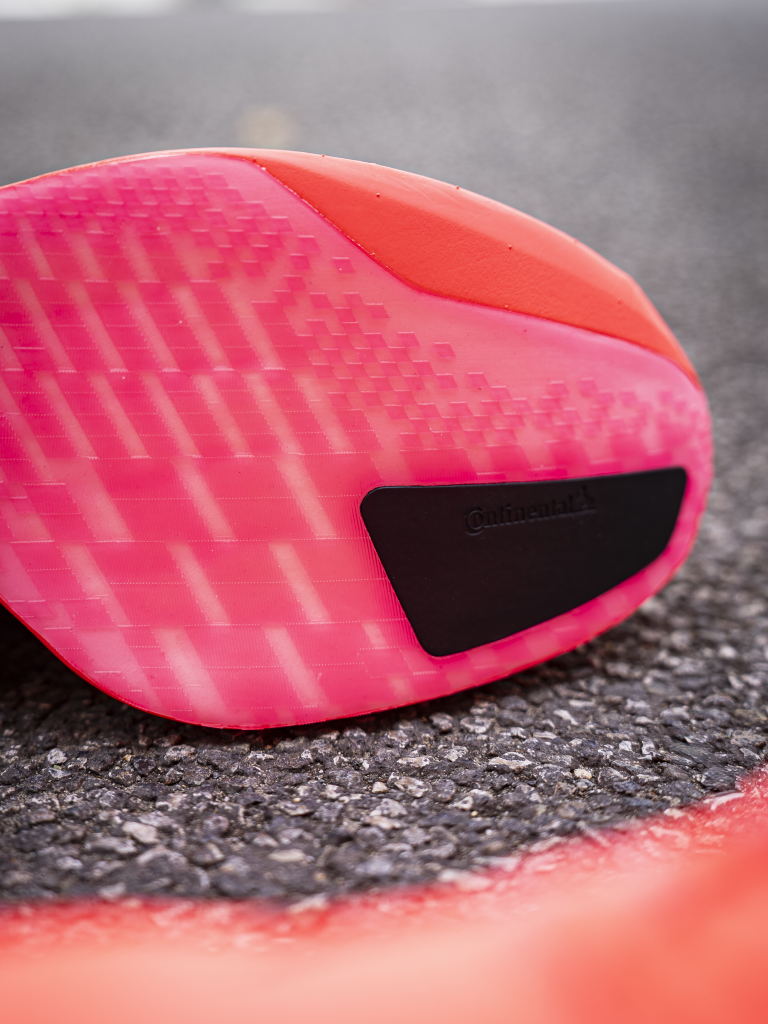
The outsole uses what adidas calls “Light Traction”, with a small Continental rubber insert right at the front. Grip is okay, not amazing, just okay, it works for what you need. This is a shoe built around asphalt running, not something meant for trail or off-road use. I didn’t expect much beyond that, and it delivers exactly what’s expected there. Grippy enough, does the job.
The main issue for me is that it’s not the most durable, and the outsole coverage is quite sheer. This leads straight into my next point.
Durability
Durability is honestly my biggest concern with this shoe, coming in at €260, slightly more than the previous iteration. You don’t expect a shoe like this to last hundreds of kilometers, but you do expect some longevity given the price. I’ve only run in it a handful of times. Even after my second run I could already see noticeable wear or deterioration of the foam.
Some elements will probably hold up fine. But between how soft the foam is, how sheer the outsole is, and how many areas are exposed, I noticed visible wear after just a few runs. I’d guess this could be a two-to-three-marathon shoe, plus a handful of training sessions. Maybe around 300km total, which works out to almost a euro per kilometer. That said, my own usage is pretty aggressive and fast, which might not be exactly how this shoe is meant to be used. Therefore, this is something I want to keep testing and revisit.
Conclusion
Value for Money
At €260, this is probably on the more affordable side for a shoe in the current mass-market carbon-plate segment. Compared to something like the Hoka Cielo X1 3.0 or the New Balance SC Elite v5, both of which sit around $20-30 more, this shoe honestly delivers better performance for the money.
That said, worth keeping in mind: now that the Pro 5 is out, the Pro 4 is likely to hit discount pricing, and I actually think the Pro 4 might be the better shoe for a lot of people once its price drops closer to half of what the Pro 5 costs. Keep an eye out for that. I’d expect the Pro 5 itself to become a really great option once it sees its own discount down the line too, definitely worth grabbing at that point.
Fitting it into a shoe rotation
This sits clearly as a marathon and long-distance rotation shoe rather than a speed-day option. It’s not for sub-3-hour marathoners only either. You don’t need elite speed to get the benefits here. This makes it accessible to a much wider range of runners training for longer distances, a market that’s clearly growing.
Final Verdict
The adidas Adios Pro 5 is a shoe that trades some of the Pro 4’s edge for comfort and accessibility. Depending on what you’re after, that’s either exactly what you want or a real letdown. It’s lightweight, bouncy, and snappy at toe-off. It does what it needs to for marathon and long-run efforts.
That said, it lacks some of the lively, aggressive ride I’d have expected from the world record breaking brand. My biggest hesitation is durability: visible wear after just a couple of runs at this price point is a real concern. For now, this reads as a properly comfort-first, mass-market marathon shoe rather than the aggressive step-down racer I expected.
Comparisons Against Similar Shoes
adidas Adios Pro 5 vs. TYR Valkyrie Elite v2

The Valkyrie Elite v2 is much softer and way more aggressive than the Pro 5, it’s not the kind of shoe you could comfortably walk around in, whereas the Pro 5 is far more forgiving and handles slower paces much better. It really comes down to audience. The Pro 5 is for the masses, the Valkyrie Elite is really top end speed and purely performance oriented.
adidas Adios Pro 5 vs. New Balance SC Elite v6

Apples and pears with the New Balance SC Elite being a lot less enjoyable for me. Both foams have similar density in being very soft, but I think the NB is probably even a bit softer. Very different sensations with the plates, where new balance is super close to the foot while the adios pro is only around the foot, so the rigidity comes from a different place. Overall I would recommend adidas 10 times out of 10 for all profiles from recreational to elite runners.
adidas Adios Pro 5 Quick Questions
How should I use the adidas Adios Pro 5?
Use it as a comfort-oriented marathon and long-run shoe which is accessible for all but still providing a fast speedy run sensation.
Is the adidas Adios Pro 5 a good shoe for long runs?
Yes, its a great long run companion for those who want to add speed work into their run, I wouldn’t recommend it for recovery/easy long runs.
Is the adidas Adios Pro 5 a good shoe for fast sessions?
Yes, but better oriented for tempo work rather than all out speed. Anything 5k pace and up.
Is the adidas Adios Pro 5 a shoe for daily training?
Not really, it’s a carbon-plated race and workout shoe rather than an everyday trainer.
Can I wear the adidas Adios Pro 5 as a lifestyle shoe?
No, it’s a performance racing shoe rather than a lifestyle sneaker, so it’s best for running.
Is the adidas Adios Pro 5 suitable for all terrains?
No, it’s specifically for asphalt and road running, not trail or off-road use.
Is the adidas Adios Pro 5 a good shoe for racing?
Yes, particularly for marathon and long-distance racing rather than shorter, faster race distances.
Is the adidas Adios Pro 5 a good shoe for stability?
Yes, the rigid ENERGYRIM gives it a stable, controlled ride despite the soft foam and max stack platform underneath.

